Judaism
Genesis
“And Abram fell on his face: and God talked with him, saying,”
Across these traditions, physical lowering of the body serves as a primary grammar of awe and submission before the divine. While the gesture universally marks a boundary between the human and the sacred, its liturgical integration varies significantly. In Islam, prostration is codified into daily ritual prayer, whereas in the Abrahamic and Dharmic examples cited, it often responds to specific theophanic revelations. Scholars debate whether these acts represent distinct theological categories of worship or a shared phenomenological response to transcendence.
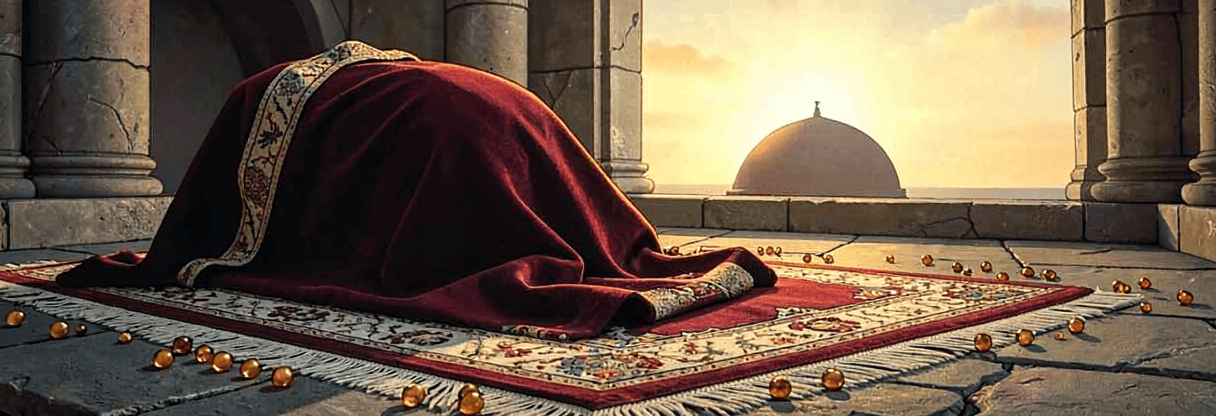
Across the Abrahamic traditions, the physical lowering of the body serves as a primary grammar of awe, marking the boundary between the finite human and the infinite sacred. In Judaism, this gesture often functions as a protective posture before direct revelation, as seen when Abram falls on his face during the covenantal encounter in Genesis 17:3, signaling readiness to receive divine instruction. Similarly, in Christianity, the disciples' reaction to the Transfiguration in Matthew 17:6 illustrates how prostration accompanies overwhelming theophanic fear, though it remains a spontaneous response to epiphany rather than a codified liturgy. This creates a distinct tension where reverence competes with angelic commands to stand. Islam, however, institutionalizes this phenomenological response into the daily rhythm of worship. The command in Surah 96:19 to "prostrate, and draw near" transforms the spontaneous act of fear into a mandatory ritual of submission (sujood) within the five daily prayers. While all three traditions utilize the gesture to acknowledge divine transcendence, the divergence lies in its integration: Judaism and Christianity often reserve it for specific, disruptive moments of revelation, whereas Islam embeds it as a constant, repetitive reminder of the believer's ontological dependence on Allah. Thus, the same bodily movement oscillates between a momentary shield against the holy and a structured discipline of humility.
Moses and Abraham fall on their faces specifically during covenantal encounters or divine judgment. This suggests prostration functions as a protective or preparatory posture before direct revelation.
Disciples fall on their faces primarily during epiphany moments like the Transfiguration rather than as a standard liturgy. This highlights a tension between reverence and the command to stand in certain angelic visitations.
Prostration (sujood) is integrated into the five daily prayers as a mandatory act of submission. This institutionalizes the gesture as a constant reminder of the believer's relationship to Allah.
Bowing low — the spiritual posture that every tradition treats as the door, not the threshold. From Moses 'meek above all men' to the Tao that humbles itself by being below.
The still small voice — every tradition keeps a chamber of quiet at the centre of speech. The God who speaks in whispers, the Tao that knows the world without going out.
He that is greatest among you shall be your servant — every tradition reverses the order of greatness and makes the servant the model of the saint.
Every knee shall bow — every tradition reads the bending of the knee as the body's confession before the Holy and as the posture from which all real prayer rises.
No one has written anything here yet. Some places to begin:
Sign in to join the discussion.