Judaism
2 Kings
“He removed the high places, and brake the images, and cut down the groves, and brake in pieces the brasen serpent that Moses had made: for unto those days the children of Israel did burn incense to it: and he called it Nehushtan.”
This parallel examines the motif of prophetic iconoclasm as a definitive rupture with ancestral polytheism. While the narrative of Abraham smashing idols in the Qur'an serves as a paradigmatic origin story for monotheistic rejection of images, the Hebrew Bible presents Moses destroying the Golden Calf and Hezekiah later dismantling the Nehushtan as acts of cultic purification within an established covenant. Christian tradition, particularly in Acts 17, shifts the focus from physical destruction to rhetorical deconstruction of idols in the Athenian Areopagus, reflecting a different missionary strategy. Scholars debate whether the Abraham narrative in the Qur'an is a midrashic elaboration of Genesis or an independent tradition emphasizing the prophet's logical refutation of idolatry.
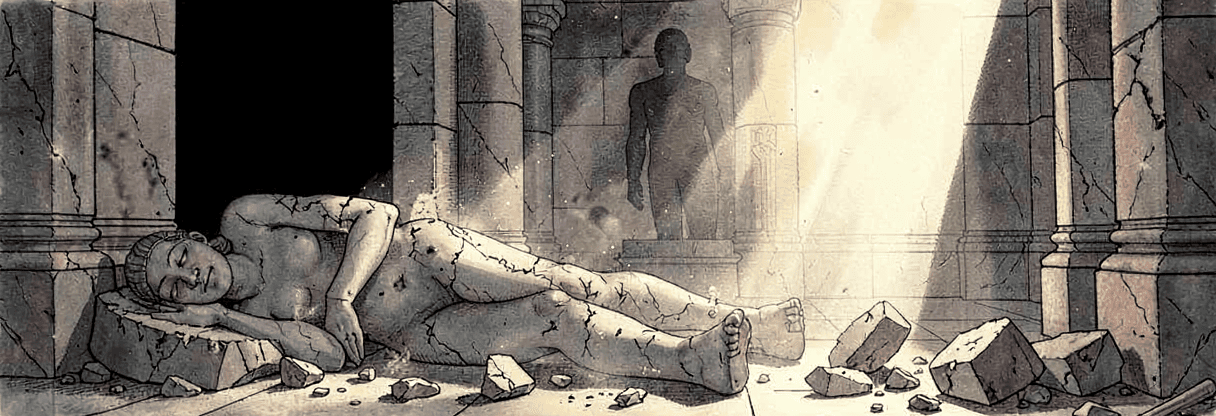
The motif of breaking idols serves as a critical boundary marker across monotheistic traditions, delineating the exclusive sovereignty of the Divine against ancestral polytheism. In the Hebrew Bible, this iconoclasm functions primarily as cultic purification within an established covenant. King Hezekiah's dismantling of the Nehushtan illustrates a nuanced reality: even legitimate symbols can devolve into idolatry, necessitating physical removal to restore proper worship (2 Kings 18:4). Conversely, the Qur'anic narrative of Abraham presents a paradigmatic origin story where the prophet, often depicted as a youth, employs dialectical reasoning to expose the futility of man-made gods before shattering them. As Surah 21:58 recounts, he breaks them "into pieces, all except the chief of them," inviting a logical return to the Creator, while Surah 37:91 affirms the Lord of the heavens as the sole originator. This emphasizes the intellectual foundation of tawhid prior to physical action. Christian tradition, particularly in Acts 17, shifts the paradigm from physical destruction to rhetorical deconstruction. Paul's address in the Athenian Areopagus argues that the Creator "dwelleth not in temples made with hands" (Acts 17:24), reflecting a missionary strategy that transcends material representation entirely. While Judaism and Islam often necessitate the physical rupture of the idol to re-establish covenantal fidelity, Christianity frequently locates the victory over idolatry in the theological assertion of God's transcendence, rendering the material object spiritually null without requiring its destruction.
In the Hebrew Bible, the destruction of idols is often framed as a cultic reform or a response to immediate apostasy rather than a pre-prophetic origin story. The destruction of the bronze serpent by Hezekiah highlights that even legitimate symbols can become idolatrous over time, a nuance less prominent in the Abrahamic narratives.
The Qur'anic account of Abraham is unique in depicting the prophet as a child or youth who uses dialectical reasoning to expose the futility of idols before physically destroying them. This narrative emphasizes the intellectual and logical basis of tawhid (monotheism) as a precursor to the physical act of iconoclasm.
The New Testament account of Paul in Athens does not record physical destruction of idols but rather a theological argument that God does not dwell in temples made by hands. This reflects a shift from cultic purification to the proclamation of a God who transcends material representation entirely.
Placing anything above God in one's life leads to spiritual emptiness and separation. The scriptures warn against worshipping created things rather than the Creator.
The first sin of the angels and the last sin of the saints — the inflation of self that every tradition treats as the secret root of every other vice.
The first sin of the spirit, the recurring sin of the people — every tradition tells of the proud refusal that sets the soul against its source.
No one has written anything here yet. Some places to begin:
Sign in to join the discussion.