Judaism
Genesis
“In the same day the LORD made a covenant with Abram, saying, Unto thy seed have I given this land, from the river of Egypt unto the great river, the river Euphrates:”
Across these traditions, the covenant represents a binding agreement initiated by the deity and ratified through specific ritual or testimonial acts. While Judaism and Christianity emphasize blood as the sealing agent of the bond, Islam locates the covenant in a pre-temporal affirmation of divine lordship. Scholars note that the Christian new covenant explicitly positions itself as a fulfillment and transformation of the Mosaic precedent. The shared motif of divine fidelity persists despite these divergent mechanisms of ratification.
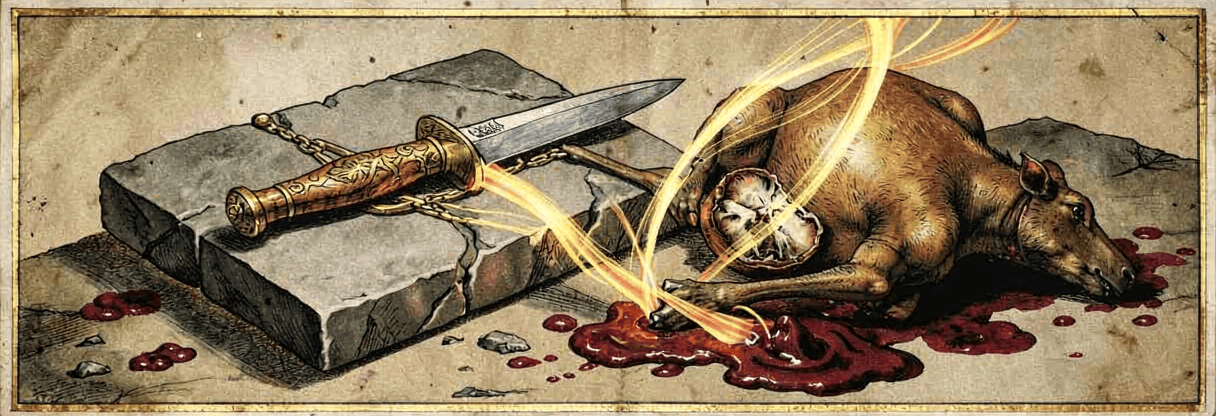
The motif of covenant cutting reveals a profound theological convergence across Judaism, Christianity, and Islam regarding divine initiative in establishing sacred bonds. In the Hebrew Bible, this relationship is historically enacted through visceral ritual; Genesis 15 describes the division of carcasses, while Exodus 24:8 records Moses sprinkling blood upon the people, declaring, "Behold the blood of the covenant." This act signifies a life-for-life exchange, grounding the community's identity in a tangible, sacrificial ratification. Christianity retains this blood symbolism but reinterprets it christologically. The Gospel of Luke presents the Eucharist as the "new testament in my blood," shifting the locus of mediation from animal sacrifice to the person of Jesus. As Hebrews 8:6 argues, this constitutes a "better covenant" that fulfills and transforms the Mosaic precedent. Conversely, Islamic theology diverges by locating the covenant not in historical blood rites but in a primordial, pre-temporal affirmation. Surah 7:172 depicts Allah bringing forth the seed of Adam to testify, "We hear and we obey," as noted in Surah 5:1. Here, the binding agreement relies on innate recognition of divine lordship rather than external sacrificial enactment. While Judaism and Christianity emphasize the sealing power of blood, Islam prioritizes the memory of this original testimony. Despite these divergent mechanisms of ratification, all three traditions maintain that divine fidelity remains the unshakeable foundation of the sacred relationship.
The ritual enactment involves the physical division of carcasses and blood sprinkling to seal the obligation historically. This blood rite signifies the life-for-life exchange inherent in the binding agreement.
The covenant is reinterpreted christologically, where the blood of the mediator replaces the animal sacrifice of the Mosaic law. This shift establishes a new theological framework for the relationship between deity and community.
The covenant is framed as a primordial testimony of lordship rather than a ritual blood-seal, emphasizing remembrance over sacrificial enactment. This distinction highlights a focus on innate recognition rather than external ritual ratification.
No one has written anything here yet. Some places to begin:
Sign in to join the discussion.