Judaism
Exodus
“And mount Sinai was altogether on a smoke, because the LORD descended upon it in fire: and the smoke thereof ascended as the smoke of a furnace, and the whole mount quaked greatly.”
Across multiple traditions, the mountain functions as an axis mundi where the divine realm intersects with the terrestrial, serving as a locus for revelation, covenant, or theophany. While the motif of elevation facilitating access to the sacred is shared, the theological implications diverge: in Abrahamic faiths, the mountain is often the site of specific historical revelation or covenantal law, whereas in Dharmic traditions, it frequently symbolizes the cosmic order or the abode of deities rather than a singular historical event. Scholars note that the 'descent' of the divine in the Bible and Qur'an contrasts with the 'ascent' of the devotee or the identification of the deity with the mountain in Hindu texts.
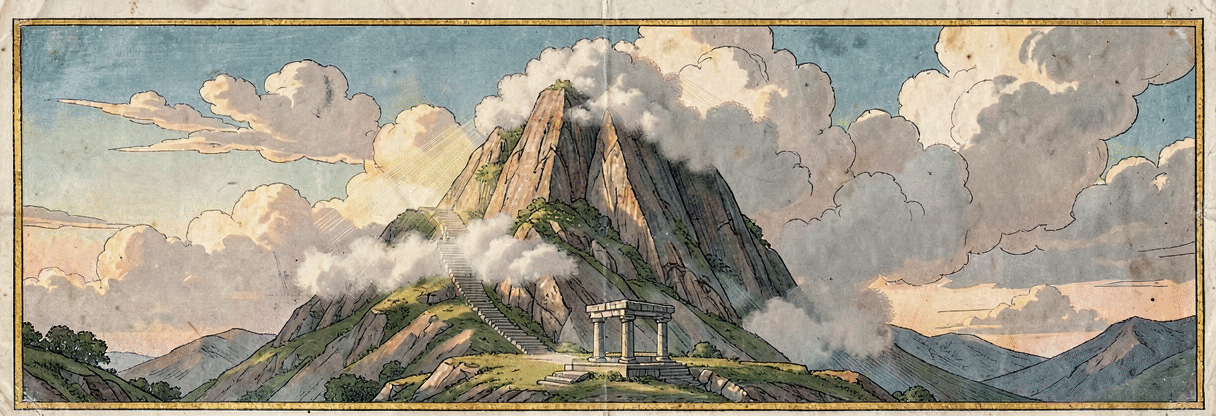
Across diverse traditions, the sacred mountain operates as an axis mundi, a liminal threshold where the terrestrial intersects the celestial. In Abrahamic faiths, this elevation facilitates a specific, historical descent of the divine will. At Sinai, the smoke and fire signify a terrifying holiness where Yahweh descends to establish covenantal law, demanding strict boundaries as described in Exodus 19:18. Similarly, in Islam, Mount Hira serves as the catalyst for the initial revelation, where the command to "Read!" initiates the final scripture, emphasizing divine instruction over spatial permanence. Christianity reorients this motif at the Mount of Olives, where the Ascension marks not a giving of law, but the departure of the incarnate Christ, shifting focus toward eschatological return. Conversely, Dharmic traditions often conceptualize the mountain as an enduring symbol of cosmic order or the intrinsic nature of the deity itself. In the Bhagavad Gita, Krishna identifies with Meru, stating, "of mountains I am Meru," thereby internalizing the sacred geography rather than locating revelation at a singular historical moment. While the Abrahamic narratives prioritize a unique, binding event occurring upon the peak, Hindu thought frequently views the mountain as a perpetual embodiment of cosmic eminence or a pilgrimage center for realizing the divine presence already inherent in the world. Thus, the shared motif of elevation diverges fundamentally: one tradition seeks the law given from the height, while the other recognizes the height as the law itself.
In the Sinai narrative, the mountain is a place of terrifying holiness where the law is given, requiring strict boundaries to prevent unauthorized access, emphasizing the transcendence of God.
The Mount of Olives serves as the site of the Ascension, where the physical body of Jesus departs earth, shifting the focus from a place of law-giving to a point of eschatological departure and promise of return.
Mount Hira is the site of the initial revelation (Wahy) to the Prophet, marking the beginning of the final scripture, where the mountain is the catalyst for the recitation rather than a place of covenantal law.
In the Gita, Krishna names Meru among the heights of his own divine glory ('of mountains I am Meru'), where the mountain is invoked as a token of cosmic eminence rather than a singular site of historical revelation. The Hindu sacred mountain typically functions as cosmic axis (Meru) or pilgrimage centre (Kailasa, Govardhan), not as the locus of one binding covenantal event.
No one has written anything here yet. Some places to begin:
Sign in to join the discussion.