Judaism
Exodus
“And when the LORD saw that he turned aside to see, God called unto him out of the midst of the bush, and said, Moses, Moses. And he said, Here am I.”
This comparative motif centers on theophany through fire that defies natural combustion, marking a sacred boundary between the human and divine. In the Hebrew Bible and Christian Acts, the event reveals the divine name YHWH and commissions Moses for liberation. The Qur'anic narratives parallel this with Musa at the valley of Tuwa, emphasizing divine oneness and ritual purity through the removal of sandals. Scholars note that while the core imagery of unconsumed fire is shared, the theological framing varies between covenantal history, typological fulfillment, and prophetic selection.
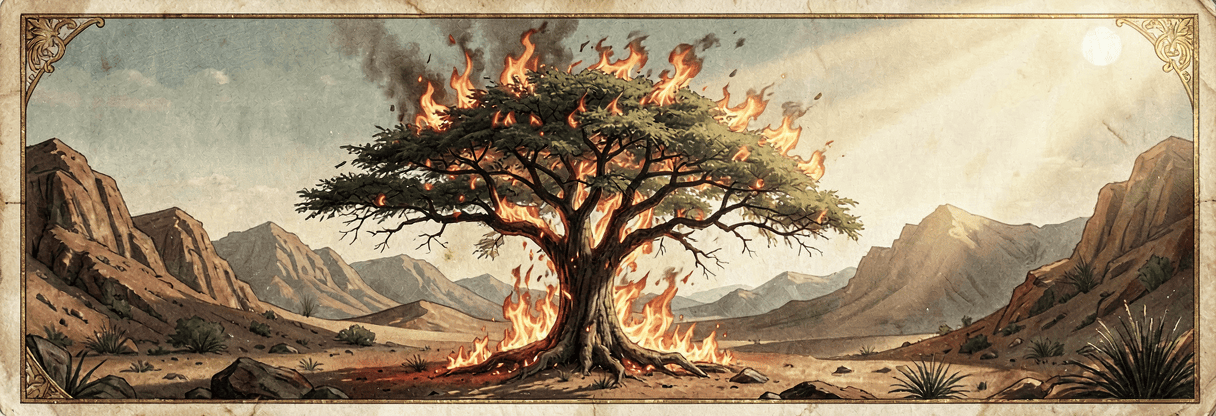
The motif of the burning bush represents a profound intersection of divine presence and human limitation across Abrahamic traditions. In each narrative, fire manifests without consuming the vegetation, signaling a sacred boundary between mortal and eternal. Exodus 3:4 records God calling "Moses, Moses" from the midst of the bush, establishing a covenantal identity rooted in patriarchal history. Similarly, the Qur'an recounts Musa at the valley of Tuwa, where divine speech commands, "So pluck off thy sandals" (Surah 20:11). This act of removing footwear marks the ground as holy, a shared ritual of purity emphasizing the prophet's humility before the Absolute. However, theological framing diverges regarding revelation. The Hebrew Bible focuses on the revelation of the divine name YHWH and the specific liberation of Israel. In contrast, Islamic accounts emphasize Tawhid and Musa's selection as a messenger without explicit covenantal naming. Christianity, particularly in Stephen's speech in Acts 7:31, reframes the event typologically. Here, Moses wonders at the sight as the voice of the Lord comes, prefiguring the resurrection and the unquenchable life found in Christ. While the core imagery of unconsumed fire unites these texts, the purpose shifts from national liberation to universal monotheism or soteriological fulfillment. Thus, the bush remains a symbol of divine immanence, yet interpretation reflects distinct communal identities and soteriological goals.
The narrative emphasizes the revelation of the divine name YHWH, establishing a covenantal identity rooted in patriarchal history. The focus remains on the liberation of Israel and the sanctity of the land.
Stephen's speech in Acts reframes the event as a typological precursor to the resurrection and the rejection of the law by the Jewish leaders. The burning bush becomes a symbol of the unquenchable life found in Christ.
The Qur'anic accounts emphasize the sanctity of the valley of Tuwa and the direct command to remove sandals as a sign of purity. The dialogue centers on Tawhid and Musa's selection as a messenger without the explicit covenantal naming of YHWH.
Trust as substance — the faculty that the Letter to the Hebrews names the evidence of things unseen, and that every tradition makes the seed of every virtue.
The 'beginning of wisdom' that every tradition distinguishes from terror — the awe of the small soul before the unbearable nearness of the Holy.
Naming as a sacred act — the Tetragrammaton, the ninety-nine names of Allah, the syllable OM, the Tao that cannot be named. Every tradition makes the Name the place where speech meets the unspeakable.
The divine summons — every tradition turns on the moment a voice names a name and a life turns. Abram. Moses. Mary. Muhammad. Siddhartha.
The high place where the air thins and the soul meets the Holy — Sinai, Olives, Hira, Meru, Tabor.
Burning bush, refiner's flame, consuming holiness — every tradition makes fire the proximity of God and the test of the soul.
No one has written anything here yet. Some places to begin:
Sign in to join the discussion.