Judaism
Genesis
“And the dove came in to him in the evening; and, lo, in her mouth was an olive leaf pluckt off: so Noah knew that the waters were abated from off the earth.”
The dove functions as a potent symbol of peace, divine presence, and return across Abrahamic traditions, though its theological weight varies significantly. In Judaism, the bird signifies the cessation of divine wrath and the restoration of the covenant through the olive leaf, while in Christianity, it embodies the indwelling of the Holy Spirit at the inauguration of Jesus' ministry. Scholars note that while the Jewish narrative emphasizes a return to a renewed earth, the Christian account focuses on the descent of a divine agent for anointing, creating a divergence between a sign of peace and a manifestation of power.
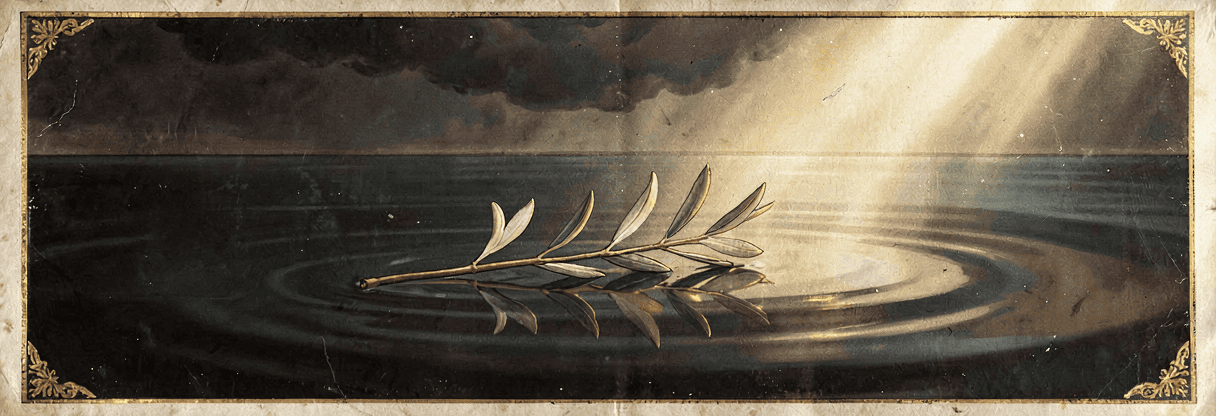
In the Abrahamic traditions, the dove emerges as a multifaceted symbol bridging divine judgment and renewal, yet its theological function diverges significantly between Jewish and Christian narratives. In the Hebrew Bible, specifically Genesis 8:11, the dove serves as a functional agent of discovery, returning to Noah with an olive leaf to signal the cessation of the Flood and the restoration of the covenant with creation. Here, the bird marks a transition from divine wrath to earthly peace, emphasizing a renewed relationship between the Creator and the physical world. The imagery in Song of Solomon 2:14 further personalizes this motif, addressing the faithful as a dove in the clefts of the rock, suggesting intimacy and safety amidst turmoil. Conversely, the Gospels reconfigure this symbol from an external sign of peace to an internal manifestation of divine power. In Matthew 3:16 and Mark 1:10, the Spirit descends like a dove upon Jesus at his baptism, not to report on a restored earth, but to anoint him as the Son of God. This shift transforms the dove from a scout of a renewed world into the visible presence of God Himself, inaugurating a new era of spiritual transformation. While both traditions utilize the bird to denote a pivotal new beginning, Judaism focuses on the restoration of the created order, whereas Christianity emphasizes the ontological presence of the divine within the human person, creating a meaningful distinction between a sign of peace and a manifestation of power.
In the Hebrew Bible, the dove acts as a scout returning with evidence of life, symbolizing the end of the Flood and the renewal of the covenant with creation. The bird's role is functional and indicative of a restored relationship between God and the earth.
In the New Testament, the dove descends upon Jesus as a visible manifestation of the Holy Spirit, signifying his anointing and divine sonship rather than a return to a physical location. This shifts the motif from a sign of external peace to an internal, ontological presence of God.
No one has written anything here yet. Some places to begin:
Sign in to join the discussion.