Christianity
Matthew
“Go ye therefore into the highways, and as many as ye shall find, bid to the marriage.”
This motif depicts a divine invitation extended to a broad populace, where initial refusal by the privileged leads to the inclusion of the marginalized. In the Synoptic Gospels, the parable explicitly narrates the rejection by invited guests and the subsequent gathering of the poor and outcasts. While Isaiah 25 prophesies a universal eschatological banquet on Mount Zion, it lacks the specific narrative element of the invited guests' refusal and replacement. Islamic eschatology describes the righteous reclining in gardens of paradise, yet the textual focus remains on the reward for the faithful rather than a parable of replacement for those who decline the initial summons.
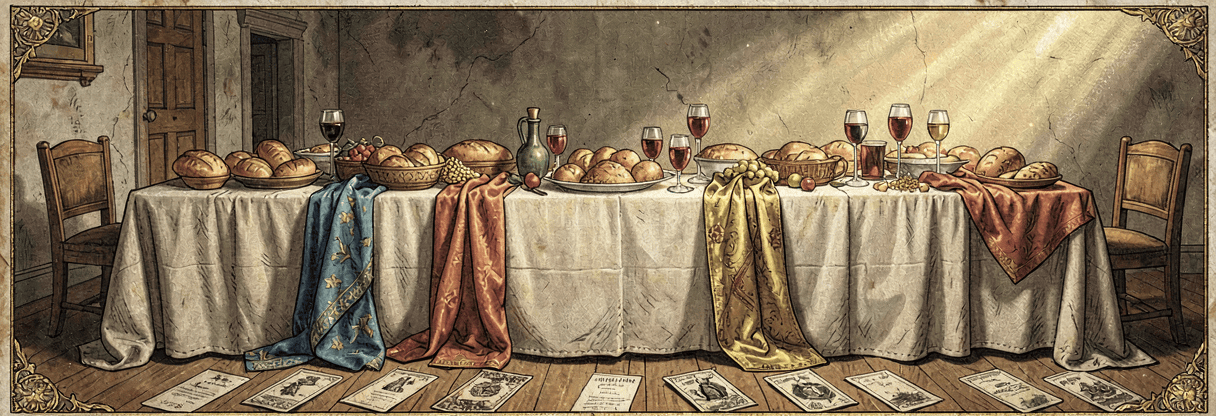
The motif of the divine banquet serves as a potent eschatological symbol across Abrahamic traditions, signifying ultimate communion with the Creator within a royal or paradisiacal realm. In the Synoptic Gospels, this imagery becomes a narrative of radical inclusion. Matthew 22:9 records the king's command to "Go ye therefore into the highways, and as many as ye shall find, bid to the marriage," while Luke 14:23 intensifies this with the instruction to "compel them to come in." Here, the initial refusal by the privileged necessitates the gathering of the marginalized, functioning as a theological allegory for the shift from a specific covenant to a universal one. Conversely, the Hebrew prophetic tradition in Isaiah 25:6 envisions a "feast of fat things" for all peoples on Mount Zion, yet it presents this as a divine decree rather than a parable of rejected invitations. The focus remains on the abolition of death and the universal scope of salvation without the specific mechanism of guest replacement. Islamic eschatology similarly depicts the righteous reclining on couches in gardens, as seen in Surah 56:15 and Surah 52:20, emphasizing the eternal reward for the faithful. However, these texts describe the state of the "Companions of the Right" rather than narrating a sequence of invitation and refusal. Thus, while all three traditions affirm a future feast of divine presence, the Christian narrative uniquely utilizes the banquet to dramatize the ethical imperative of replacing the unresponsive with the outcast.
The narrative explicitly details the rejection of the initial invitees and the king's command to bring in the poor, maimed, and those from the highways. This functions as a specific theological allegory for the inclusion of Gentiles and the exclusion of those who reject the prophetic message.
The text presents a prophetic vision of a universal feast of fat things for all peoples, emphasizing the removal of the veil of death. It lacks the narrative mechanism of a rejected invitation and a subsequent replacement of guests found in the parabolic tradition.
The passages describe the state of the 'Companions of the Right' reclining on couches in gardens, focusing on the reward for the pious rather than a narrative of invitation and refusal. The emphasis is on the eternal nature of the reward and the presence of pure spouses, distinct from the parabolic structure of replacement.
Food often symbolizes provision, communion, and celebration in the biblical narrative. Jesus identifies himself as the bread of life for eternal sustenance.
Who rules, and rightly — every tradition tests the throne against the prophet, the conscience, and the Holy.
The reaping at season's end — every tradition treats the gathered grain as figure of judgment, of mission, of the soul's gathered fruit.
The set table that anticipates the kingdom — every tradition imagines the end as a feast, and rebukes the soul that comes uninvited or refuses the call.
No one has written anything here yet. Some places to begin:
Sign in to join the discussion.