Christianity
Romans
“And if some of the branches be broken off, and thou, being a wild olive tree, wert graffed in among them, and with them partakest of the root and fatness of the olive tree;”
This parallel examines the motif of the wild stock joined to the cultivated tree, found explicitly in Pauline theology and metaphorically in prophetic and Qur'anic imagery. While Christianity articulates a soteriological grafting of Gentiles into the historic people of God, Judaism employs the olive tree as a symbol of Israel's intrinsic, divinely rooted vitality, and Islam utilizes the tree metaphor to describe the stability of the believer's faith rather than a structural union with a prior lineage. Scholars note that the Pauline concept of grafting implies a conditional inclusion dependent on faith, whereas the prophetic and Qur'anic images emphasize the organic, unbroken continuity of the righteous community.
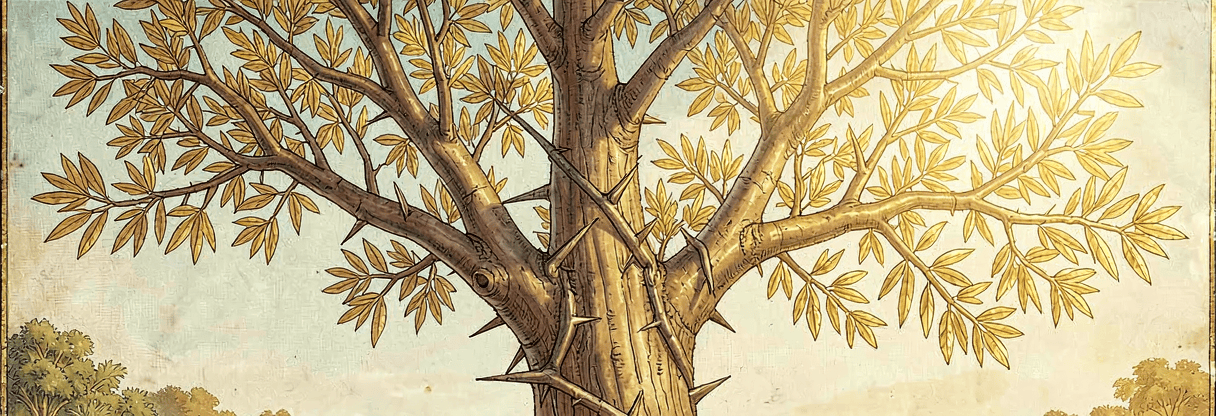
The arboreal metaphor serves as a profound nexus for examining divine-human relations across the Abrahamic traditions, yet the mechanics of inclusion vary significantly. In Pauline theology, specifically Romans 11:17, the wild olive branch represents the Gentile believer grafted into the cultivated stock of Israel. This act is a soteriological intervention, reversing natural order to create a new, conditional unity dependent on faith. Conversely, the Hebrew prophetic tradition, as seen in Jeremiah 11:16, depicts Israel itself as the 'green olive tree,' inherently goodly and divinely rooted. Here, the imagery emphasizes intrinsic identity and the severe consequences of covenantal breaking, lacking the Pauline notion of external grafting. The Qur'anic narrative in Surah 14:24 further diverges by presenting the 'goodly tree' as a singular entity where the believer's word possesses firm roots and lofty branches. This metaphor focuses on the internal stability and organic integrity of faith rather than the structural integration of distinct ethnic or religious groups. While all three traditions warn that separation from the root leads to withering, Christianity uniquely frames the relationship as an artificial grafting of the wild into the cultivated. Judaism and Islam, by contrast, prioritize the organic continuity of the righteous community, viewing the tree not as a site of structural merger but as a symbol of inherent, unbroken vitality rooted directly in the Divine.
Paul introduces the unique theological concept of 'grafting in' a wild olive branch (Gentiles) into a cultivated tree (Israel), emphasizing a reversal of natural order based on faith. This diverges from the other traditions by framing the relationship as an artificial, soteriological intervention rather than an organic growth.
The prophetic texts utilize the olive tree as a native metaphor for Israel's established identity, focusing on the tree's inherent beauty and the consequences of breaking its branches through covenant violation. The imagery here presumes an intrinsic, ungrafted status for the people, contrasting with the Pauline narrative of external inclusion.
The Qur'anic parable of the goodly tree describes the believer's word as a single entity with firm roots and high branches, lacking the dual-structure of wild and cultivated stocks. This reflects a focus on the internal stability of faith rather than the historical or ethnic integration of distinct groups.
The tree of life, the tree of knowledge, the Bodhi tree, the tree planted by water — every tradition makes the rooted, fruit-bearing tree the figure of the righteous soul and of cosmic order.
The cultivated stock that bears fruit only when grafted to the root — every tradition makes the vine the figure of the people of God and of the soul that abides in the Word.
No one has written anything here yet. Some places to begin:
Sign in to join the discussion.