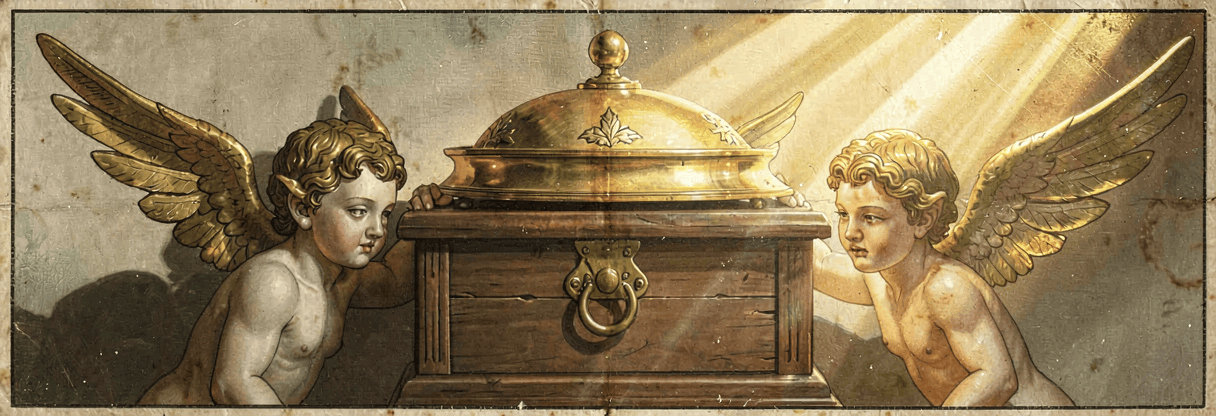
On The Mercy Seat
The concept of a divine locus of atonement and covenantal presence unites these traditions, though the mechanism of access differs significantly. Judaism locates this in the physical kapporet of the Tabernacle, requiring priestly mediation and blood sacrifice. Christianity reinterprets the kapporet typologically, identifying Christ himself as the propitiation where God meets humanity. Islam presents the Throne of God as the ultimate seat of authority and mercy, though it is transcendent and not a site of sacrificial atonement in the Levitical sense.

Across the Abrahamic traditions, the concept of a divine locus for atonement and presence serves as a profound theological anchor, yet the mechanisms of access reveal distinct soteriological paths. In Judaism, the kapporet functions as a tangible, sanctified point of contact. As Exodus 25:22 declares, God meets the High Priest "from above the mercy seat, from between the two cherubims," emphasizing a mediated encounter bound by ritual law and the annual sprinkling of blood on Yom Kippur. This preserves a strict distinction between the holy and the profane, where mercy is enacted through specific priestly action. Christianity reinterprets this typology, shifting the locus from an object to a person. Romans 3:25 identifies Christ as the propitiation "through faith in his blood," arguing that his sacrificial death fulfills and supersedes the Levitical system, rendering the physical temple obsolete. Here, the cherubim's role is internalized within the believer's direct access to God. Islam diverges significantly by transcending localized sacrificial sites entirely. The Qur'an describes the Throne (Arsh) in Surah 2:255 as encompassing all creation, symbolizing absolute sovereignty rather than a specific meeting point for blood sacrifice. Divine mercy is accessed through direct supplication and divine decree, without human intermediaries or ritual atonement. While all three traditions affirm a seat of mercy flanked by celestial guardians, Judaism emphasizes ritual mediation, Christianity centers on historical incarnation, and Islam prioritizes transcendent sovereignty.
What every account tells.
- iA specific locus where the Divine presence is most intensely manifested.
- iiThe association of this locus with divine mercy and forgiveness.
- iiiThe necessity of a mediating element (blood, person, or divine decree) to approach the holy.
- ivThe presence of cherubim or angelic guardians flanking the divine seat.
- vThe establishment of a covenantal relationship between God and the people through this seat.
How each tradition tells it.
The kapporet is a physical gold lid atop the Ark of the Covenant, serving as the specific point of contact for the High Priest once a year on Yom Kippur. The mercy is enacted through the sprinkling of sacrificial blood, maintaining a distinction between the holy and the profane.
The New Testament authors identify Jesus as the antitype of the mercy seat, arguing that his death serves as the final propitiation for sin. This shifts the locus of atonement from a ritual object to a historical person, rendering the physical temple obsolete.
The Throne (Arsh) is described as vast and encompassing, symbolizing God's absolute sovereignty rather than a localized meeting place for sacrifice. Divine mercy is accessed through direct supplication and divine decree, without the need for a physical intermediary or blood sacrifice.
Read the passages as one.
Discussion
No one has written anything here yet. Some places to begin:
- Which tradition's framing of this idea felt strongest to you, and why?
- What's missing from this comparison — a tradition or a passage that should be here?
- Has reading these side-by-side changed how you'd read any of them alone?
Sign in to join the discussion.