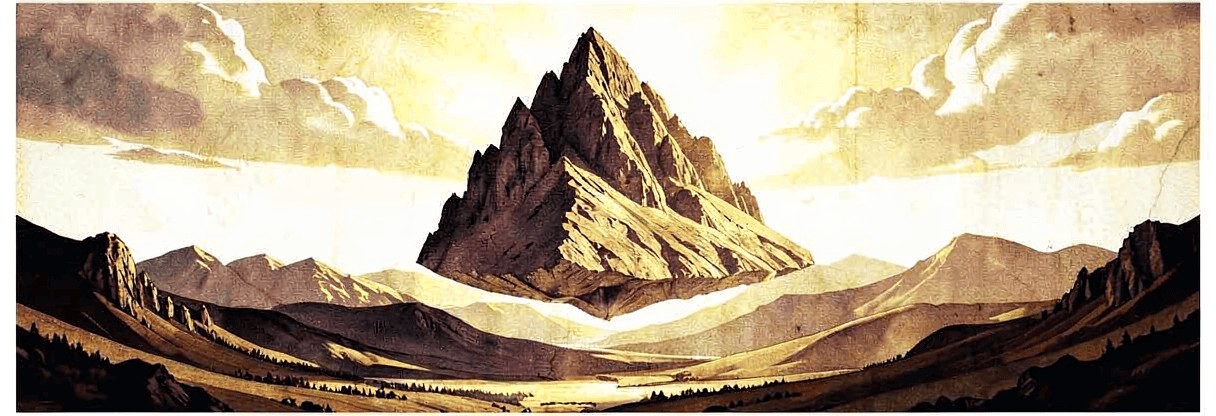
On Faith That Moves Mountains
The motif of mountain removal serves as a potent symbol for overcoming insurmountable obstacles through divine agency or human faith across traditions. While Christianity and Islam both utilize the image to illustrate the limits of human belief versus divine power, Judaism employs the metaphor primarily within a prophetic and eschatological context of restoration. Scholarly debate persists regarding whether these accounts reflect literal cosmological expectations or purely rhetorical hyperbole emphasizing the efficacy of prayer and trust in the divine.

The motif of mountain removal functions as a profound theological metaphor across Abrahamic traditions, symbolizing the transcendence of divine power over insurmountable obstacles. In the Synoptic Gospels, Jesus declares that faith "as a grain of mustard seed" can command a mountain to cast itself into the sea, emphasizing the internal quality of trust over external magnitude. This soteriological focus is nuanced by Pauline literature, which subordinates such miraculous faith to the primacy of charity. Conversely, Jewish prophetic literature, particularly Zechariah 4:7, addresses the "great mountain" before Zerubbabel, framing the leveling not as an individual test of belief but as a historical and eschatological restoration of Jerusalem. Here, the metaphor signifies God's sovereignty over political powers rather than human spiritual potency. Islamic discourse, found in Surah 13:31, adopts a distinct polemical stance; the Qur'an posits that even if mountains were moved, disbelievers would not believe without divine will. This passage, alongside eschatological descriptions of cosmic dissolution, contrasts the fragility of the physical world with the permanence of revelation. While all three traditions agree that divine agency is the ultimate mover, they diverge significantly on the catalyst: Christianity highlights individual faith, Judaism emphasizes prophetic restoration, and Islam underscores the futility of signs without divine decree. Thus, the mountain serves not merely as a barrier but as a mirror reflecting each tradition's unique understanding of the relationship between human agency and divine sovereignty.
What every account tells.
- iThe mountain represents an insurmountable obstacle or cosmic barrier.
- iiDivine power is the ultimate agent of the removal.
- iiiHuman agency (faith or prophecy) acts as the catalyst for the divine intervention.
- ivThe removal signifies a transition from chaos or opposition to order or peace.
How each tradition tells it.
In the Synoptic Gospels, the removal of the mountain is explicitly conditioned on the internal state of the believer's faith, specifically the 'mustard seed' metaphor, suggesting a soteriological focus on the quality of trust rather than the magnitude of the miracle itself. Pauline literature further reframes this capability, subordinating the power to move mountains to the necessity of charity, thereby critiquing faith without love.
The prophetic literature of Zechariah and Habakkuk utilizes the mountain metaphor to describe the historical and eschatological leveling of political powers opposing God's people, rather than a test of individual faith. The imagery is deeply tied to the restoration of Jerusalem and the cosmic upheaval preceding the Day of the Lord, emphasizing God's sovereignty over history rather than human spiritual potency.
The Qur'anic discourse on moving mountains serves as a polemic against the demand for physical signs, asserting that even if the mountains were moved, the disbelievers would not believe without divine will. The motif is frequently eschatological, describing the cosmic dissolution of the earth on the Day of Judgment, contrasting the permanence of divine revelation with the fragility of the physical world.
Read the passages as one.
Where else this study appears.
Discussion
No one has written anything here yet. Some places to begin:
- Which tradition's framing of this idea felt strongest to you, and why?
- What's missing from this comparison — a tradition or a passage that should be here?
- Has reading these side-by-side changed how you'd read any of them alone?
Sign in to join the discussion.