Judaism
Exodus
“And the LORD went before them by day in a pillar of a cloud, to lead them the way; and by night in a pillar of fire, to give them light; to go by day and night:”
The motif of a visible, mobile divine presence guiding a community through wilderness terrain appears prominently in the Hebrew Bible and is reinterpreted in the New Testament and the Qur'an. While the Hebrew Bible describes a literal pillar of cloud and fire leading the Israelites, the New Testament typologically identifies this event as a prefiguration of Christian baptism and spiritual sustenance. The Qur'an affirms the guidance of Moses but omits the specific pillar imagery, focusing instead on divine provision and the separation of the sea as signs of Allah's protection.
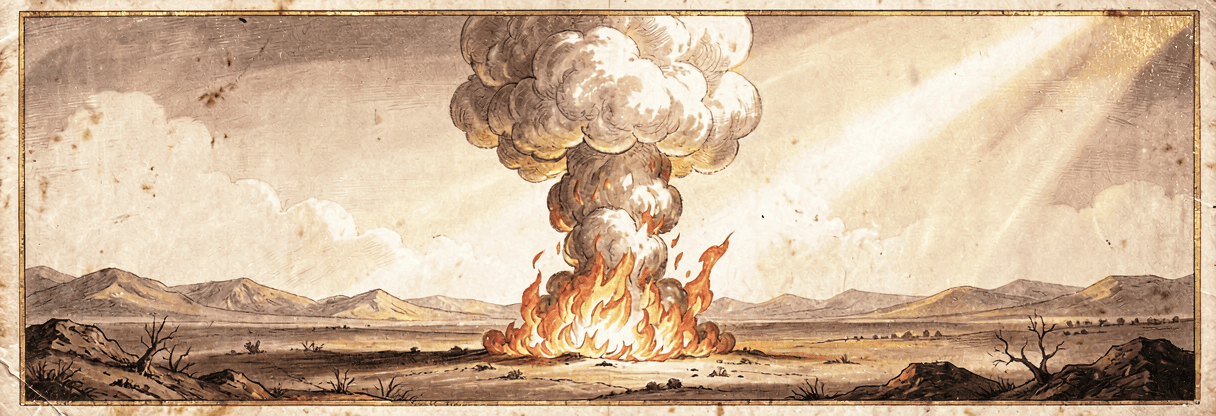
The motif of a visible, mobile divine presence guiding a community through hostile wilderness terrain serves as a profound point of convergence and divergence across the Abrahamic traditions. In the Hebrew Bible, Exodus 13:21-22 describes the Lord leading the Israelites "by day in a pillar of a cloud" and "by night in a pillar of fire," a distinct physical theophany that dictates the rhythm of their journey. This tangible manifestation underscores a covenantal relationship where God's immanence is spatially and temporally continuous, marking the people as uniquely guided toward a promised destination. Christianity reinterprets this literal phenomenon through a typological lens. In 1 Corinthians 10:1-2, the Apostle Paul identifies the cloud not merely as a meteorological sign but as a prefiguration of baptism, shifting the focus from physical navigation to spiritual initiation and Christological fulfillment. Conversely, the Qur'an affirms the guidance of Moses and the protection of the Israelites but omits the specific pillar imagery. Surah 2:50 highlights the parting of the sea, while Surah 2:57 mentions a "white cloud" overshadowing the people alongside the provision of manna and quails. This divergence suggests a theological emphasis in Islam on divine power and sustenance rather than the specific mechanism of theophanic guidance. While all three traditions recognize a deity actively shepherding a community through peril, the nature of that guidance oscillates between literal manifestation, sacramental symbol, and testament to sovereign provision.
In the Hebrew Bible, the pillar is a distinct, physical theophany that moves independently of the people, signaling when to break camp or encamp. Scholars debate whether this reflects a historical meteorological phenomenon or a theological construct emphasizing God's immanence.
The New Testament reinterprets the pillar not as a literal cloud but as a typological precursor to the sacrament of baptism and the spiritual rock that followed the Israelites. This shift moves the focus from physical guidance to spiritual initiation and Christological fulfillment.
The Qur'an recounts the guidance of Moses and the Israelites but does not explicitly mention the pillar of cloud or fire, instead emphasizing the splitting of the sea and the provision of manna and quails. This divergence suggests a theological focus on divine power and sustenance rather than the specific mechanism of theophanic guidance.
The veil of glory — every tradition makes the cloud the place where presence is hidden and revealed, where the voice speaks and the eye must drop.
Unshaken foundation — every tradition names the divine as the Rock under the feet of the faithful and the cleft in which the soul is hid.
No one has written anything here yet. Some places to begin:
Sign in to join the discussion.