Judaism
Genesis
“I do set my bow in the cloud, and it shall be for a token of a covenant between me and the earth.”
In the Abrahamic traditions, the rainbow serves as a divine sign of a covenant following a cataclysmic flood, marking a shift from judgment to preservation. While Judaism and Christianity explicitly identify the bow as a memorial of God's promise never to destroy the earth by water again, Islamic exegesis focuses on the survival of the prophet Nuh and his followers as the fulfillment of divine mercy, with the rainbow often interpreted in later tradition as a sign of God's power rather than a contractual stipulation. Scholars note that the Genesis narrative uniquely personifies the bow as a weapon hung up by God, a motif absent in the Qur'anic account which emphasizes the immediate salvation of the believers.
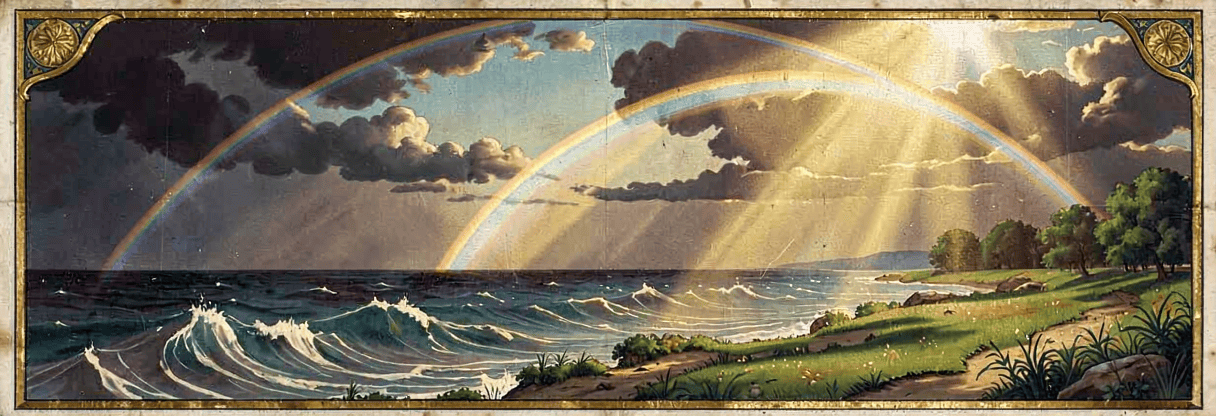
In the Abrahamic corpus, the rainbow emerges as a potent symbol of divine restraint following cataclysmic judgment. Genesis 9:13 explicitly frames this phenomenon as a covenantal token: "I do set my bow in the cloud," establishing a permanent memorial between the Creator and all living creatures. This narrative uniquely personifies the bow as a weapon of war suspended in the heavens, signifying that God will no longer wield it against the earth. Judaism and Christianity thus share a legalistic understanding of the sign as a binding promise of non-destruction. Conversely, the Qur'anic account in Surah Hud (11:44) focuses on the immediate cessation of the deluge and the salvation of the believers, stating, "And it was said, O earth, swallow up thy water." While later Islamic exegesis associates the rainbow with God's mercy, the text itself lacks the explicit contractual stipulation found in Genesis. Furthermore, Christian tradition expands the motif eschatologically; Revelation 4:3 depicts a rainbow encircling the divine throne, shifting the symbol from a historical guarantee of preservation to a vision of God's sovereign presence in the end times. Thus, while all three traditions recognize the celestial arc as a testament to mercy, the Jewish and Christian texts emphasize a universal, binding covenant, whereas the Islamic narrative prioritizes the deliverance of the faithful, and the New Testament reimagines the sign as a marker of ultimate divine authority.
The text explicitly frames the bow as a sign of the covenant between God and every living creature, emphasizing the universal scope of the promise. The bow is described as a weapon of war that God has placed in the clouds to signify that He will no longer use it against the earth.
While retaining the Noahic covenant, the New Testament introduces a distinct apocalyptic image where a rainbow encircles the throne of God, symbolizing divine presence and judgment in the end times. This shifts the motif from a historical promise of non-destruction to an eschatological symbol of God's sovereignty.
The Qur'anic narrative focuses on the command to build the ark and the subsequent salvation of the believers, without an explicit verse establishing the rainbow as a covenant sign in the same legalistic manner as Genesis. Traditional tafsir often links the rainbow to God's attributes of power and mercy, but the text itself emphasizes the deliverance of Nuh's community as the primary outcome of the flood.
No one has written anything here yet. Some places to begin:
Sign in to join the discussion.