Judaism
Psalms
“The LORD is my shepherd; I shall not want.”
The motif of the divine or human leader as a shepherd who intimately knows the flock and assumes the risk of predation is a pervasive archetype in the Ancient Near East, serving as a metaphor for political and spiritual authority. While Judaism and Christianity emphasize the personal, sacrificial intervention of the shepherd against the wolf, Islam frames the prophetic role more as a divinely appointed guide for a unified community, and Taoism presents the ideal ruler as one who guides without overt interference. Scholars debate whether the Christian emphasis on the shepherd laying down his life represents a unique theological innovation or a radicalization of existing royal metaphors found in Ezekiel and the Psalms.
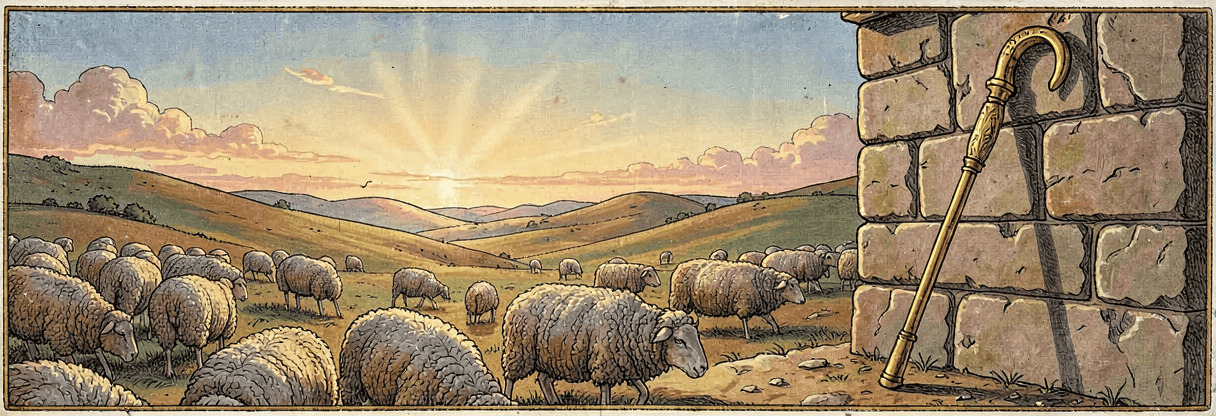
The shepherd metaphor permeates the Ancient Near East, establishing authority through intimate care rather than coercion. In the Hebrew Bible, this imagery bridges the divine and the royal: Psalm 23:1 declares, "The LORD is my shepherd," while Ezekiel 34:10 condemns corrupt leaders, promising Yahweh will personally rescue the flock. This tradition emphasizes the restoration of a community under a Davidic figure or direct divine rule, critiquing exploitation. Christianity radicalizes this archetype by transforming the political metaphor into a soteriological event. In John 10:11, Jesus identifies as the "good shepherd" who "giveth his life for the sheep," distinguishing himself from the hireling who flees the wolf. This voluntary self-sacrifice marks a unique theological innovation where the shepherd's death becomes the means of salvation. Conversely, the Qur'an frames the prophetic role differently. Surah 35:24 emphasizes the messenger as a guide sent to unify the Ummah under God's command, focusing on collective direction rather than the shepherd's personal atonement. Meanwhile, Taoist thought subverts the active shepherding model entirely. The Tao Te Ching 17:1 describes the ideal ruler whose existence is barely known, guiding through non-action so the flock feels it achieved success independently. Thus, while all traditions value protective guidance, they diverge sharply on the mechanism: divine intervention, sacrificial death, communal direction, or effortless non-interference.
In the Hebrew Bible, the shepherd motif is often applied to human kings (David) and God, with a strong prophetic critique (Ezekiel 34) against leaders who exploit the flock rather than protect it. The focus is frequently on the restoration of the community under a Davidic figure or Yahweh's direct rule.
Christianity uniquely identifies the shepherd as the one who voluntarily lays down his life for the sheep, transforming the political metaphor into a soteriological event of self-sacrifice. This distinguishes the 'Good Shepherd' from the 'hireling' who flees at the sight of the wolf.
The Qur'anic usage focuses on the Prophet as a messenger sent to guide the community to the truth, emphasizing the unity of the flock under God's command rather than the shepherd's personal sacrifice. The shepherd imagery is less about individual intimacy and more about the collective guidance of the Ummah.
Taoist texts subvert the traditional shepherd metaphor by suggesting the ideal ruler guides the people so subtly that they feel they have achieved their own success. The 'shepherd' does not actively fight wolves but creates an environment where the flock thrives through non-action (wu wei).
No one has written anything here yet. Some places to begin:
Sign in to join the discussion.