Judaism
Daniel
“I beheld till the thrones were cast down, and the Ancient of days did sit, whose garment was white as snow, and the hair of his head like the pure wool: his throne was like the fiery flame, and his wheels as burning fire.”
Abrahamic traditions converge on the imagery of a supreme divine tribunal where cosmic order is restored through the assessment of human deeds. While Judaism and Christianity emphasize the visual majesty of the Ancient of Days and the Great White Throne, Islam introduces the specific mechanism of the scales to weigh actions. Scholars note that the Christian synthesis of judgment often incorporates ethical dichotomies absent in the more legalistic or cosmic balancing found in Jewish and Islamic eschatologies.
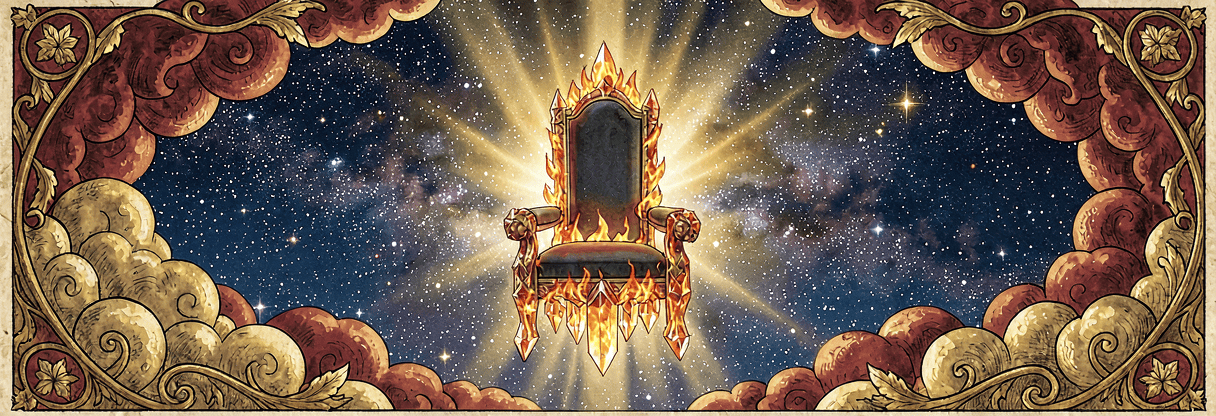
Across the Abrahamic spectrum, the imagery of the divine tribunal serves as a culminating point where cosmic order is restored through the assessment of human conduct. In the Hebrew Bible, Daniel 7:9-10 depicts the Ancient of Days seated upon thrones, surrounded by myriads, emphasizing God's sovereign victory over chaos rather than a forensic ledger of individual sins. This vision affirms ultimate justice without detailing the mechanics of moral accounting. Christianity expands this imagery in Revelation 20:11-12, introducing the Great White Throne where the dead stand before God and books are opened, framing judgment through the lens of Christ's authority and a sharp ethical dichotomy between the righteous and the wicked. Islam converges on the necessity of divine evaluation but diverges significantly by introducing the physical scales of justice. As Surah 101:6-8 and Surah 7:8 illustrate, even an atom's weight of good or evil is measured, reflecting a precise legalistic balance where the individual's book is presented directly. While all three traditions affirm an inescapable divine judgment determining eternal destiny, the Jewish focus remains on cosmic sovereignty, the Christian narrative on resurrection and ethical separation, and the Islamic tradition on the meticulous weighing of deeds. These variations reveal distinct theological priorities: the affirmation of order, the finality of moral choice, and the precision of divine retribution, respectively.
The focus remains on the cosmic sovereignty of the Ancient of Days rather than a detailed ledger of individual moral accounting. The imagery serves to affirm God's ultimate victory over chaos rather than a forensic trial of souls.
Judgment is framed through the lens of Christ's authority and the separation of humanity into distinct ethical categories, such as sheep and goats. The throne is explicitly identified as the Great White Throne, emphasizing the finality of the resurrection and the opening of books.
The tradition uniquely emphasizes the physical weighing of deeds on scales, where even an atom's weight of good or evil is accounted for. This reflects a precise legalistic balance where the book of deeds is presented directly to the individual.
The call to order rightly what power has bent — a thread that runs from the prophets to the caliphs to the Mahabharata.
Resurrection, heaven and hell, the wheel of samsara, the bodhisattva's return — visions of what lies beyond the body.
The doorway every tradition stands at without averting its eyes — Ecclesiastes' dust to dust, Paul's sting that has been swallowed, the Buddha's first noble truth.
The seat above the cherubim — every tradition figures the divine sovereignty as a throne, attended by the unceasing song of those who see and do not look away.
He that endureth to the end — every tradition lives toward an end, and every tradition holds that the end is not the close of the story but the door of the longer one.
No one has written anything here yet. Some places to begin:
Sign in to join the discussion.