Christianity
Acts
“And there appeared unto them cloven tongues like as of fire, and it sat upon each of them.”
This parallel examines the motif of divine speech manifesting as or accompanied by fire across Abrahamic traditions. In Christianity, the Holy Spirit descends as cloven tongues of fire enabling glossolalia; in Judaism, the prophetic word is explicitly compared to a burning fire that consumes; in Islam, the burning bush serves as the medium for divine address to Moses. While all three utilize fire to signify the purifying and empowering nature of revelation, they diverge on whether the fire is the medium of the voice itself or a symbol of the message's potency.
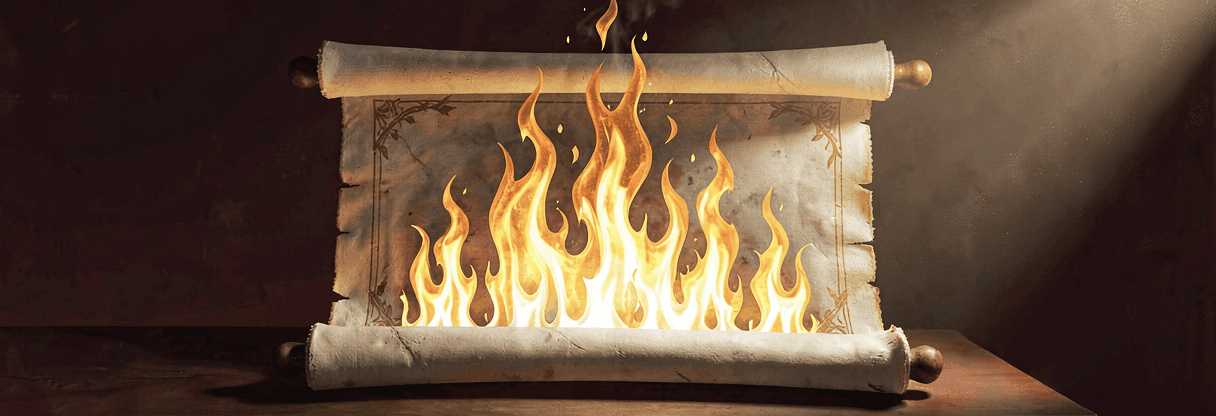
Across Abrahamic traditions, fire frequently marks the threshold of divine communication. In Christianity, Acts 2:3 describes "cloven tongues like as of fire" resting upon disciples, enabling glossolalia. Here, fire empowers the community for universal mission. Conversely, Judaism often treats fire as a metaphor for the prophetic word's potency. Jeremiah 23:29 asks, "Is not my word like as a fire?" emphasizing the message's destructive power against falsehood rather than a visual theophany. Islam presents a narrative middle ground. In Surah 28:30, the burning bush serves as the locus for God's address to Moses, "O Musa! Lo! I am Allah, the Lord of the Worlds." The bush burns without consuming, signifying sanctification. While all three utilize fire to signify divine presence and purification, the mechanics diverge significantly. Christianity visualizes the Spirit as tongues enabling speech; Judaism conceptualizes the word itself as fire; Islam locates the voice within the miraculous flame. Each tradition balances the terrifying power of revelation with the preservation of the recipient. The fire sanctifies rather than destroys, yet its function ranges from enabling speech to embodying the message's weight. These distinctions reveal how each community understands the interface between the human and the holy, shaping their respective theological landscapes regarding revelation and authority.
The fire appears as distinct 'tongues' resting upon individuals, directly enabling the physical act of speaking in other languages as a sign of universal mission. The fire is the visible manifestation of the Spirit empowering the community rather than a singular theophany to one prophet.
The text employs a simile rather than a narrative theophany, comparing the prophetic word to fire to emphasize its destructive power against falsehood and its ability to penetrate the human heart. The focus is on the nature of the message itself as a consuming force rather than a visual sign accompanying speech.
The fire is the medium of the bush itself which burns without being consumed, serving as the location where the voice of God addresses Moses directly. The emphasis is on the miracle of the bush remaining intact while serving as the vessel for the divine declaration of Lordship.
The small member that sets the course of the whole life — every tradition treats the tongue as the visible test of the heart.
Burning bush, refiner's flame, consuming holiness — every tradition makes fire the proximity of God and the test of the soul.
He that hath an ear, let him hear — every tradition holds the ear as the first organ of faith and the first failure of the proud heart.
Thy word is a lamp unto my feet — every tradition makes the small steady light the figure of the Word that does not fail in the long dark watch.
The breath that becomes life and the spirit that becomes prayer — every tradition figures the divine in the air the body cannot keep, and yet cannot live without.
No one has written anything here yet. Some places to begin:
Sign in to join the discussion.