Christianity
1 Corinthians
“In a moment, in the twinkling of an eye, at the last trump: for the trumpet shall sound, and the dead shall be raised incorruptible, and we shall be changed.”
The motif of the trumpet appears across Abrahamic traditions as an auditory signal of divine intervention and eschatological transition. While Christianity and Islam emphasize the trumpet's role in the final resurrection and judgment, Judaism often associates the shofar with covenantal revelation and historical deliverance. Scholars note that the Islamic tradition specifies a dual-blow mechanism mediated by an angel, whereas the biblical texts vary between singular eschatological blasts and ritual uses. Despite these variations, the sound universally functions as a boundary marker between the present age and a divinely ordained future.
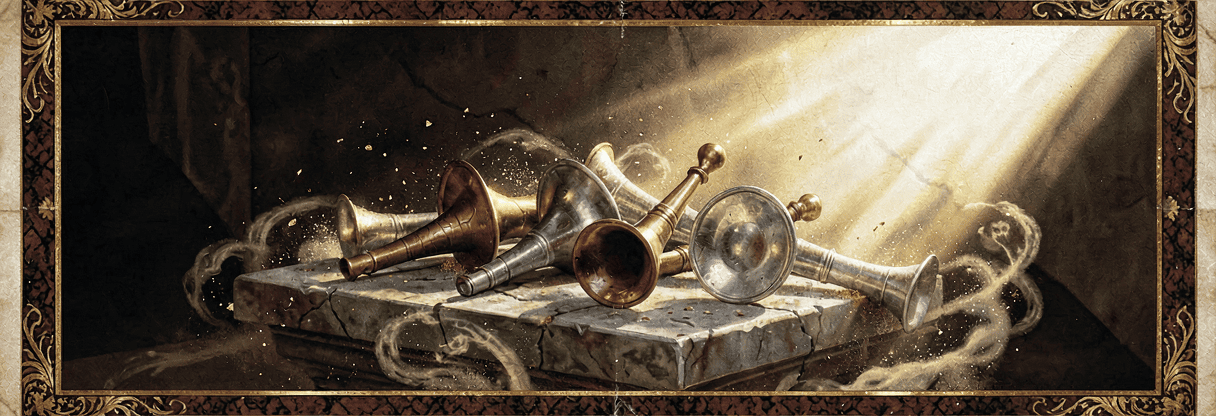
Across Abrahamic traditions, the trumpet functions as a profound auditory boundary, marking the transition from the temporal to the eternal. In Christianity, this signal is inextricably linked to the Parousia, where the "last trump" instantaneously raises the dead and transforms the living, fulfilling Pauline eschatology as seen in 1 Corinthians 15:52. Here, the blast signifies the definitive end of history and the inauguration of the resurrected state. Similarly, Islam delineates a precise cosmic mechanism mediated by the angel Israfil, who blows the trumpet twice: first to extinguish existence and again to restore it for judgment. Surah 39:68 describes this dual action, where all beings swoon save those willed by Allah, emphasizing a structured, two-stage resurrection. Judaism, while sharing the motif of divine intervention, often grounds the shofar in historical and covenantal contexts rather than solely the end times. At Sinai, the sound accompanied the theophany, as noted in Exodus 19:16, serving as a call to covenantal renewal and repentance within history. While Christianity and Islam focus on the trumpet as the agent of final resurrection, Judaism frequently employs it to awaken the community to divine presence in the present. Despite these divergent applications—whether as a singular eschatological climax, a dual-stage cosmic reset, or a recurring covenantal summons—the shared function remains constant: the sound asserts divine authority, shattering the status quo to reveal a new ontological reality ordained by the Divine.
The trumpet signals the immediate transformation of the living and resurrection of the dead at the Parousia. This eschatological event marks the culmination of Pauline soteriology.
The shofar serves primarily as a covenantal marker of God's presence and a call to repentance or battle within history. Its function is often tied to theophany rather than solely the end of time.
The blast is explicitly mediated by the angel Israfil and occurs in two stages separating death from the final standing. This dual-blow structure defines the mechanics of the Day of Resurrection.
No one has written anything here yet. Some places to begin:
Sign in to join the discussion.