Judaism
Exodus
“And it came to pass on the third day in the morning, that there were thunders and lightnings, and a thick cloud upon the mount, and the voice of the trumpet exceeding loud; so that all the people that was in the camp trembled.”
The motif of the mountain serves as a universal liminal space where the divine intersects with the human in these three traditions. In Judaism and Islam, the peak functions primarily as a site of revelation and divine oath, often associated with law or prophetic history. Christianity reinterprets this geography through the Transfiguration, where the mountain becomes a locus of Christological fulfillment rather than legal codification. Scholars debate whether these narratives represent independent developments or a shared ancient Near Eastern heritage regarding sacred topography.
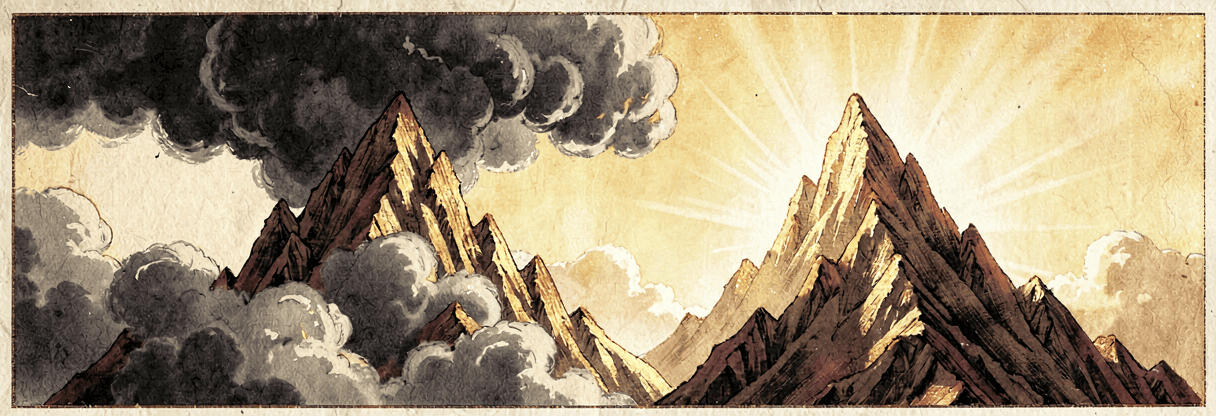
Across Judaism, Christianity, and Islam, the mountain operates as a critical liminal threshold where the terrestrial meets the celestial. In the Hebrew Bible, Exodus 19:16 depicts Sinai as a site of terrifying holiness, marked by 'thunders and lightnings' that enforce a strict boundary between the divine and the people. Here, the peak functions primarily as a locus of legal codification, emphasizing God's unapproachable nature and the necessity of Mosaic mediation. Islam similarly invokes this topography to validate prophetic authority, as seen in Surah 95:2, which swears by 'the mount of Sinai' to anchor Muhammad's message within a continuum of earlier revelation. Yet, the mountain here serves more as a sign of divine power than a recurring site of communal law-giving. Christianity fundamentally reorients this geography through the Transfiguration. In Matthew 17:2, the mountain becomes a stage for Christological fulfillment rather than legal imposition, where Jesus's face shines 'as the sun' and his garments become 'white as the light.' This transformation internalizes the divine encounter, shifting the focus from external terror to the revelation of glory within the community. While all three traditions utilize the mountain to mediate divine presence through visible phenomena, the Jewish and Islamic narratives largely preserve the peak as a witness to covenantal history and law, whereas the Christian narrative repurposes it to signify the personification of divine law and the fulfillment of prophetic expectation.
In the Hebrew Bible, Sinai is primarily a place of terror and legal codification where the people are kept at a distance. The narrative emphasizes the unapproachable holiness of God and the necessity of mediation through Moses.
The New Testament reimagines the mountain encounter as an internalized transformation where the law is fulfilled in the person of Christ. This shift moves the focus from external fear to the revelation of divine glory within the community.
The Qur'an invokes the mountain as an oath of God's power and a sign of prophetic history rather than a recurring locus of law-giving for the community. The text uses the mountain to validate the message of Muhammad by connecting it to previous prophetic lineages.
No one has written anything here yet. Some places to begin:
Sign in to join the discussion.