Christianity
Matthew
“Enter ye in at the strait gate: for wide is the gate, and broad is the way, that leadeth to destruction, and many there be which go in thereat:”
Multiple scriptural traditions articulate a moral binarism wherein human conduct bifurcates into distinct trajectories leading to opposing eschatological or soteriological outcomes. While the motif of a 'narrow' versus 'wide' or 'righteous' versus 'wicked' path is ubiquitous, the mechanisms of navigation differ: some traditions emphasize divine election and guidance, while others focus on individual karmic accumulation or adherence to revealed law. Scholars note that the 'two paths' in Abrahamic faiths often imply a linear historical or personal destiny, whereas in Dharmic traditions, the dichotomy frequently relates to the cyclical nature of rebirth and liberation.
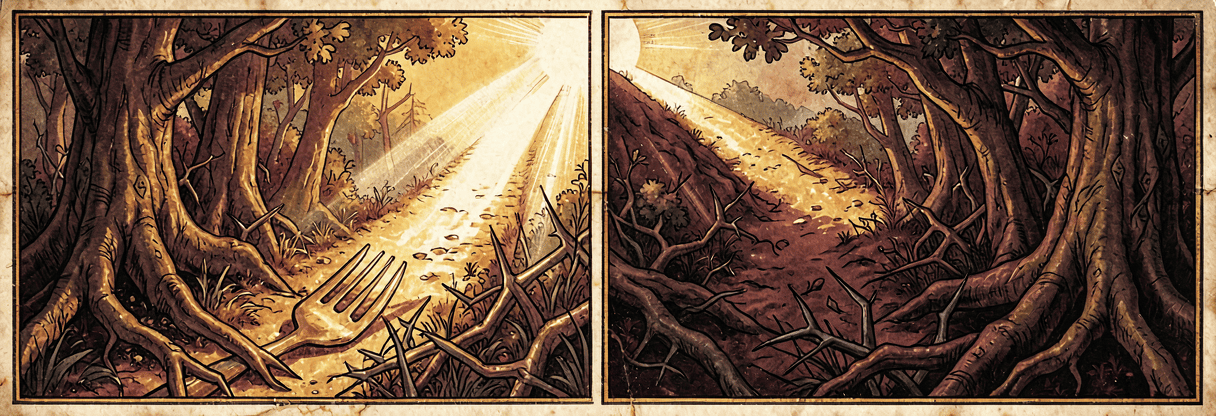
The motif of the two paths serves as a foundational ethical architecture across Abrahamic traditions, presenting human existence as a decisive bifurcation toward opposing destinies. In the Synoptic tradition, Matthew 7:13 frames this choice eschatologically: "Enter ye in at the strait gate: for wide is the gate, and broad is the way, that leadeth to destruction." Here, the narrow path demands active discipleship and is uniquely mediated through the person of Jesus, transforming moral adherence into a relational covenant. Similarly, the Hebrew Bible anchors this duality in communal fidelity; Deuteronomy 30:19 declares, "I call heaven and earth to record this day against you, that I have set before you life and death, blessing and cursing." Unlike the individualized soteriology of later Christianity, the Deuteronomic focus remains on earthly consequences and social justice within the covenant community. Islam synthesizes these elements while emphasizing divine sovereignty. Surah Al-Fatihah petitions for "The path of those whom Thou hast favoured; Not the (path) of those who earn Thine anger nor of those who go astray." This formulation highlights that remaining on the straight path (Sirat al-Mustaqim) is contingent upon divine guidance (hidayah) rather than mere human volition. While all three traditions affirm a binary moral choice governed by cosmic law, they diverge on the mechanism of navigation: Christianity centers on Christological mediation, Judaism on covenantal obedience, and Islam on the necessity of divine predestination and grace. Thus, the shared imagery of two roads reveals distinct theological anthropologies regarding human agency and salvation.
In the Synoptic tradition, the two paths are framed eschatologically, with the narrow gate requiring active discipleship and self-denial to avoid perishing. The divergence lies in the Christological claim that the path is not merely ethical but mediated through the person of Jesus.
The Deuteronomic and Psalmic traditions present the choice as a covenantal obligation between Israel and Yahweh, where the 'way of the wicked' is often associated with social injustice and idolatry. The focus remains on communal fidelity and earthly consequences rather than individual soteriological escape.
Surah Al-Fatihah explicitly petitions for the path of those granted grace, distinguishing them from those who incurred wrath or went astray. This formulation emphasizes divine predestination and the necessity of Allah's guidance (hidayah) to remain on the straight path (Sirat al-Mustaqim).
No one has written anything here yet. Some places to begin:
Sign in to join the discussion.