Christianity
John
“I am the vine, ye are the branches: He that abideth in me, and I in him, the same bringeth forth much fruit: for without me ye can do nothing.”
This parallel examines the metaphor of organic union between the divine and the believer, utilizing botanical imagery of sap, fruit, and pruning. While Christianity and Judaism share the specific motif of Israel or the believer as a vineyard tended by God, Islam adapts the imagery to a 'goodly tree' with firm roots, emphasizing stability over the specific vineyard metaphor. Hinduism contributes a distinct inverted tree (Ashvattha) representing cosmic structure and the need to sever attachment, diverging from the relational intimacy found in the Abrahamic traditions. Scholars note that while the pruning motif signifies ethical refinement in Christianity, it functions as a metaphor for detachment from the material world in the Gita.
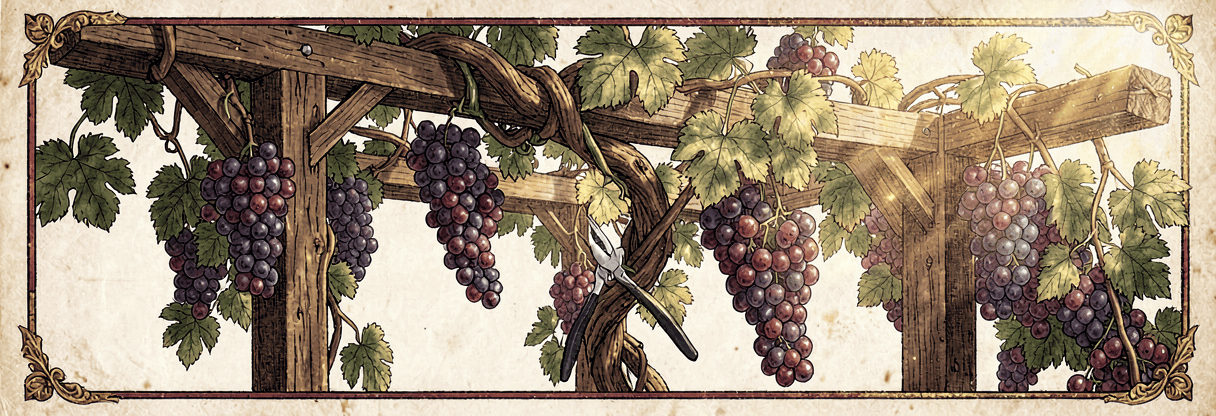
The metaphor of organic union between the divine and the believer appears across traditions, utilizing botanical imagery to articulate spiritual vitality. In Christianity, John 15:5 establishes a Christological framework: "I am the vine, ye are the branches," emphasizing mutual indwelling where divine agency sustains the believer's capacity for love. This relational intimacy finds a corporate counterpart in Judaism, where Isaiah 5:7 identifies the nation as "the vineyard of the LORD of hosts." Here, pruning signifies historical judgment and covenantal fidelity rather than individual mystical fusion. Islam adapts this botanical lexicon differently; Surah Ibrahim 14:24 presents a "goodly tree" with firm roots and high branches, symbolizing the stability of faith rather than the flow of sap. While all three traditions agree that divine agency is required for fruitfulness and that removal is necessary for health, their divergences reveal distinct theological priorities. Christianity focuses on the flow of life through the branch to the vine, Judaism on the cultivation of a specific people within history, and Islam on the unshakeable nature of the word of God. The pruning motif further illustrates this: in the Christian context, it refines the believer for greater love, whereas in Islamic thought, the emphasis shifts to the tree's inherent stability. Thus, while the organic metaphor unites these traditions in recognizing the need for rootedness and divine care, the specific imagery of vine, plantation, or tree reflects unique understandings of the believer's relationship to the sacred.
The vine metaphor is Christological, identifying Jesus as the vine and the believer as the branch, emphasizing mutual indwelling. Pruning is explicitly linked to divine discipline for increased fruitfulness in love.
The vineyard imagery is often corporate, referring to the nation of Israel as God's planting, with pruning representing historical judgment. The focus is on covenantal fidelity rather than individual mystical union.
The parable shifts from a vine to a 'goodly tree' with roots in the earth and branches in the sky, symbolizing the stability of faith. The emphasis is on the tree's unshakeable nature rather than the flow of sap or the act of pruning.
Labour as covenant: a calling, not a curse. Every tradition treats the doing of a task as a kind of prayer — Genesis tilling, Krishna karma yoga, Paul tentmaking.
The hidden chamber where the real worship happens — every tradition watches the heart more closely than the hands.
The tree of life, the tree of knowledge, the Bodhi tree, the tree planted by water — every tradition makes the rooted, fruit-bearing tree the figure of the righteous soul and of cosmic order.
The cultivated stock that bears fruit only when grafted to the root — every tradition makes the vine the figure of the people of God and of the soul that abides in the Word.
No one has written anything here yet. Some places to begin:
Sign in to join the discussion.