Christianity
Matthew
“Then the devil leaveth him, and, behold, angels came and ministered unto him.”
Multiple traditions depict a sacred figure undergoing a period of solitary testing by an adversarial force prior to the commencement of public ministry. While Christianity and Buddhism explicitly narrate a confrontation with a personal tempter (the Devil or Mara) involving specific propositions, Judaism frames the wilderness experience as a collective divine trial of fidelity without a named antagonist. Islamic tradition emphasizes the solitude of revelation and the subsequent command to preach, though the narrative of a direct, personal temptation by Satan is less central to the initial revelation event than in the other accounts. Scholars debate whether these narratives represent a shared archetypal motif of initiation or independent developments responding to similar theological needs regarding the validation of prophetic authority.
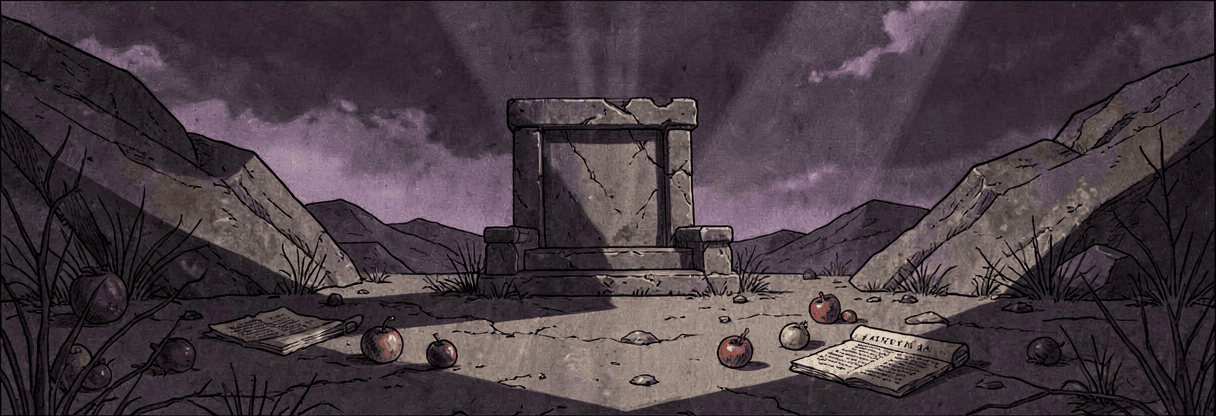
Across diverse sacral geographies, the wilderness emerges as a crucible where prophetic authority is forged through isolation and trial. In Christianity, Matthew 4:11 depicts Jesus rejecting specific worldly offers from the Devil, establishing obedience through scriptural citation. Conversely, Judaism frames this motif collectively; Deuteronomy 8:2 describes God leading Israel through forty years to humble the people, emphasizing dependence on divine provision rather than a duel with a personal adversary. While Christianity and Buddhism feature direct confrontations with personified antagonists, their resolutions diverge significantly. Jesus counters Satan with divine law, whereas the Buddha, facing Mara, achieves victory through internal mindfulness and insight, as reflected in the Dhammapada's call to conquer evil with good. Islam offers a distinct nuance; the revelation at Mount Hira emphasizes the burden of knowledge and the command to proclaim, as seen in Surah 96:5, rather than a dramatized temptation narrative. Here, the struggle is often interpreted as the internal weight of prophethood. Despite these theological variations, a shared archetype persists: the sacred figure must endure desolation to validate their mission. Whether the adversary is external or internal, the wilderness serves as the necessary threshold where human resolve meets divine purpose, transforming solitude into the foundation for public leadership.
The narrative features a direct, personal confrontation with the Devil (Satan) who offers specific worldly temptations that Jesus rejects by quoting scripture. This establishes Jesus' obedience to God in contrast to Adam's failure.
The wilderness experience is framed as a collective test of the Israelites by God rather than a personal confrontation with an adversary. The purpose is to humble the people and teach dependence on divine provision rather than to defeat a specific tempter.
The focus is on the revelation received in solitude at Mount Hira and the subsequent command to proclaim, rather than a detailed narrative of a personal temptation by Satan. The struggle is often interpreted as an internal or spiritual preparation for the burden of prophethood.
The Buddha faces Mara, a personification of delusion and death, who attempts to dissuade him from enlightenment through fear and desire. The victory is achieved through mindfulness and insight rather than scriptural citation or divine intervention.
The problem of pain. Where Buddhism begins (the First Noble Truth), Job wrestles, Paul reframes, and the Gita redirects.
The mind that hesitates between two opinions — every tradition treats it not as enemy of faith but as its proving ground.
Two natures in one creature — every tradition makes the body's appetites the testing-ground of the inner life.
Distinct from the heart: the calculating, attending faculty — that which the Buddha treats as the master, and Paul as needing renewal.
The voluntary hunger that empties the body so the soul may hear — every tradition makes the refused meal the venue of repentance, mourning, and revelation.
No one has written anything here yet. Some places to begin:
Sign in to join the discussion.