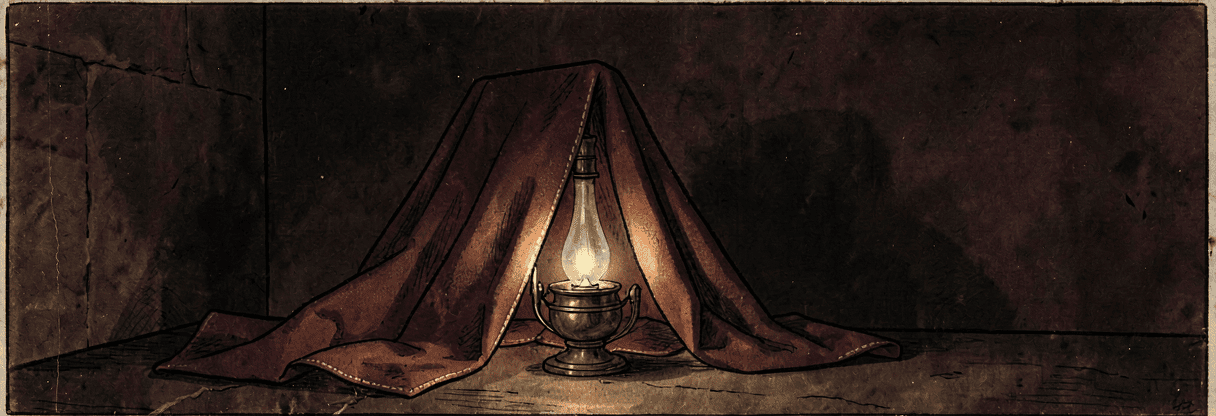
On The Secret Follower
This parallel examines the motif of religious adherence maintained in secrecy due to political or social hostility. While Christianity and Islam feature explicit narratives of individuals concealing their faith to avoid persecution, the Jewish examples provided focus on the protection of others or the concealment of identity rather than the internal state of a secret believer. Scholars note that the Christian and Islamic accounts emphasize the theological validity of hidden faith, whereas the Jewish narratives prioritize the survival of the prophetic community or the royal lineage.

The motif of concealed adherence reveals a profound tension between public identity and private conviction across the Abrahamic traditions. In Christianity, John 19:38 explicitly validates Joseph of Arimathea as a disciple who acted "secretly for fear of the Jews," suggesting that internal disposition may supersede public confession under duress. Similarly, the Qur'an highlights a believing man of Pharaoh's family in Surah 40:28 who "hid his faith," framing such dissimulation as a divinely sanctioned strategy for survival and eventual vindication. Both narratives affirm the theological legitimacy of hidden belief when faced with lethal opposition. Conversely, Jewish texts like 1 Kings 18:3 focus less on the validity of secret faith and more on the strategic preservation of the prophetic community. Obadiah, who "feared the Lord greatly," conceals the prophets' physical location to protect them from Ahab's purge, while Esther's narrative centers on the concealment of ethnic identity to ensure the survival of the people rather than the internal state of a solitary believer. Thus, while Christianity and Islam explicitly sanctify the hidden disciple's spiritual status, the Jewish tradition prioritizes the collective endurance of the covenant community. This divergence underscores a fundamental distinction: in the former, the secret believer is the primary subject of theological affirmation; in the latter, concealment serves as a tactical instrument for communal preservation against existential threats.
What every account tells.
- iAdherence to a divine mandate in the face of lethal political opposition.
- iiThe necessity of concealment to preserve life or mission.
- iiiThe presence of a high-status individual within the hostile power structure.
- ivThe tension between public identity and private conviction.
How each tradition tells it.
The narrative explicitly validates the 'secret' disciple (Joseph of Arimathea) as a legitimate follower, suggesting that the internal disposition of faith supersedes public confession when circumstances are dire. The parable of the leaven further metaphorically sanctifies hidden spiritual influence.
The cited texts focus on the concealment of the prophets' physical location or the hiding of one's ethnic identity (Esther) rather than the concealment of religious belief itself. The tension here is less about the validity of secret faith and more about the strategic preservation of the people of God.
The figure of the believing man of Pharaoh's family is presented as a model of 'taqiyya' (dissimulation) where the concealment of faith is a divinely sanctioned strategy for survival and eventual public vindication. The text explicitly states he concealed his faith, distinguishing it from mere hiding of persons.
Read the passages as one.
Where else this study appears.
Discussion
No one has written anything here yet. Some places to begin:
- Which tradition's framing of this idea felt strongest to you, and why?
- What's missing from this comparison — a tradition or a passage that should be here?
- Has reading these side-by-side changed how you'd read any of them alone?
Sign in to join the discussion.