Christianity
Revelation
“And I saw in the right hand of him that sat on the throne a book written within and on the backside, sealed with seven seals.”
This motif depicts divine revelation as a document restricted by seals or hidden within a protected register, accessible only to the worthy or at the eschaton. While Christianity and Judaism emphasize the temporal restriction of the scroll until the 'time of the end,' Islam posits an eternal, pre-existent 'Preserved Tablet' containing the uncreated Quran. Scholars debate whether the Islamic concept of the Lawh Mahfuz represents a development of the Jewish apocalyptic sealed book or a distinct theological assertion of the text's ontological independence from history.
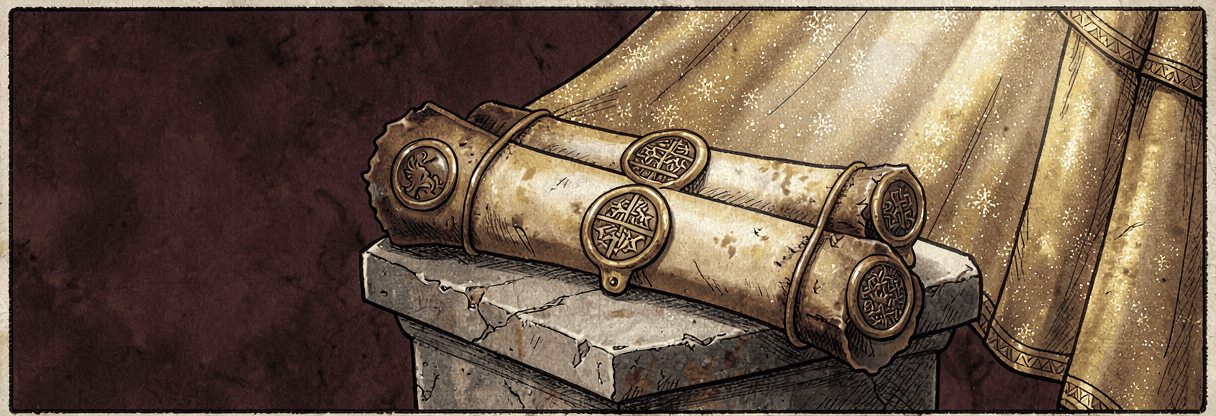
Across Abrahamic traditions, the motif of the sealed book signifies that divine knowledge is inherently guarded, accessible only through specific eschatological or spiritual authorization. In the Hebrew Bible, Daniel receives a command to "shut up the words, and seal the book, even to the time of the end" (Daniel 12:4, KJV), establishing a chronological barrier where understanding awaits the culmination of history. Similarly, Christian apocalyptic literature depicts a scroll in the divine right hand, "sealed with seven seals," whose opening depends upon the worthiness of the Lamb (Revelation 5:1, KJV). Here, restriction functions narratively to pace the revelation of judgment. Conversely, Islamic theology posits a distinct ontological divergence. The Qur'an resides in a "Preserved Tablet," described as an honourable scripture existing prior to temporal revelation (Surah 85:21-22, Pickthall). Unlike the prophetic seals of Daniel or Revelation, which delay disclosure until the end, the Islamic tablet represents an eternal, uncreated reality. This shift transforms the motif from a mechanism of future disclosure to a statement of textual permanence. While Judaism and Christianity emphasize the temporal unfolding of hidden wisdom, Islam asserts the metaphysical security of the divine word itself. Thus, the sealed book evolves from a promise of future access into a declaration of eternal presence, reflecting deeper theological commitments regarding the nature of revelation and history.
The seal functions as a narrative device delaying the disclosure of apocalyptic events until the Lamb's worthiness is established. The restriction is primarily chronological, tied to the unfolding of the seven seals.
The sealing of the book in Daniel serves as a command to the prophet to conceal the vision until the eschatological era. Here, the seal protects the prophecy from premature understanding rather than restricting access to a heavenly archetype.
The 'Preserved Tablet' is not a sealed future event but an eternal, uncreated reality where the Quran exists prior to revelation. The motif shifts from a restricted future disclosure to the ontological security of the divine word.
No one has written anything here yet. Some places to begin:
Sign in to join the discussion.