Judaism
Psalms
“Let my prayer be set forth before thee as incense; and the lifting up of my hands as the evening sacrifice.”
The imagery of incense smoke ascending serves as a universal metaphor for prayer reaching the divine across ancient Near Eastern, Jewish, and Christian traditions. While the ritual function of incense in the Hebrew Bible is tied to the sanctuary and the atonement of the priesthood, the New Testament reinterprets this imagery to describe the collective prayers of the saints as a spiritual offering. Scholars note a significant divergence wherein the later Christian text internalizes and universalizes the cultic act, whereas the Hebrew texts maintain a strict geographical and priestly limitation on the burning of incense.
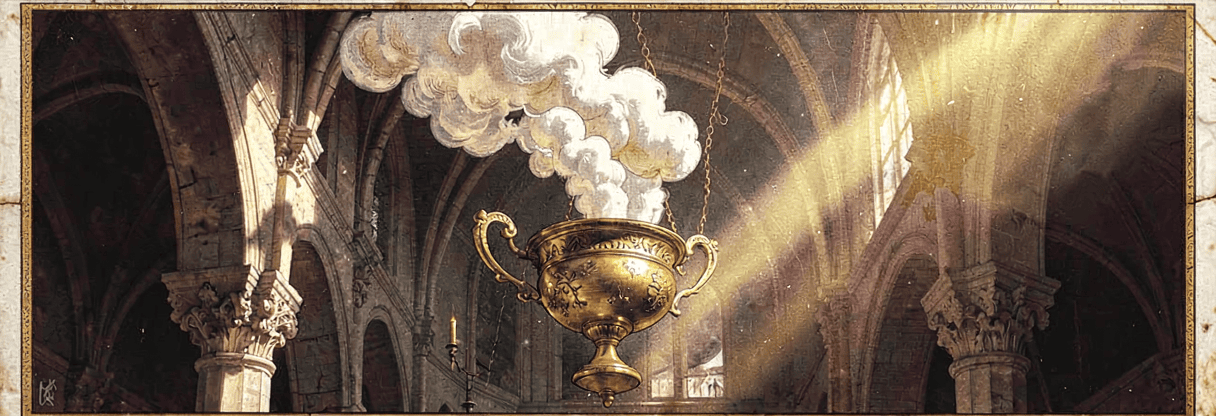
Across ancient Near Eastern and biblical traditions, the ascending smoke of incense functions as a potent metaphor for prayer reaching the divine throne. In the Hebrew Bible, this imagery remains deeply rooted in the physical sanctuary. Exodus 30:7 mandates that Aaron burn sweet incense daily within the Holy Place, establishing a strict cultic boundary where only the priesthood mediates access. Similarly, Psalm 141:2 petitions, "Let my prayer be set forth before thee as incense," yet this poetic analogy operates within a worldview where the actual burning of incense is geographically and hierarchically restricted to the Temple. The fragrance signifies the acceptability of the petition, but the act itself is bound to the high priest's specific function. The New Testament, particularly in Revelation, radically reinterprets this cultic symbol. Revelation 5:8 depicts the twenty-four elders holding golden bowls full of incense, which are explicitly identified as "the prayers of saints." Here, the physical ritual is spiritualized and universalized; the requirement for a single high priest or a specific earthly location dissolves. The collective intercession of the entire community becomes the fragrant offering before God's throne. While both traditions agree that prayer ascends like smoke and requires mediation, the divergence lies in the locus of that mediation. Judaism maintains the sanctity of the earthly sanctuary and the exclusivity of the priesthood, whereas the apocalyptic vision internalizes the rite, transforming the entire community of believers into a priestly body whose prayers constitute the eternal incense.
In the Hebrew Bible, the burning of incense is a strictly regulated cultic act performed by the high priest within the Holy Place, serving as a cloud of covering to protect the worshiper from the divine presence. The ritual is bound to the physical Tabernacle or Temple and is not generally available as a metaphor for individual prayer outside the sanctuary context.
The New Testament apocalyptic literature transforms the physical incense into a symbol for the prayers of all saints, removing the requirement for a single high priest or a specific earthly location. This shift reflects a theological move toward the spiritualization of worship, where the community's intercession itself becomes the fragrant offering before God's throne.
No one has written anything here yet. Some places to begin:
Sign in to join the discussion.