Judaism
Isaiah
“And the key of the house of David will I lay upon his shoulder; so he shall open, and none shall shut; and he shall shut, and none shall open.”
The motif of keys functions as a metonym for divine authority to admit, exclude, or control access to sacred realms or hidden knowledge. While Judaism and Christianity depict keys as delegated authority given to human agents (the house of David or the apostle Peter) to bind and loose, Islam strictly reserves the keys of the unseen (al-ghayb) exclusively for God. This divergence highlights a theological tension between participatory ecclesial authority and absolute divine omniscience regarding the hidden.
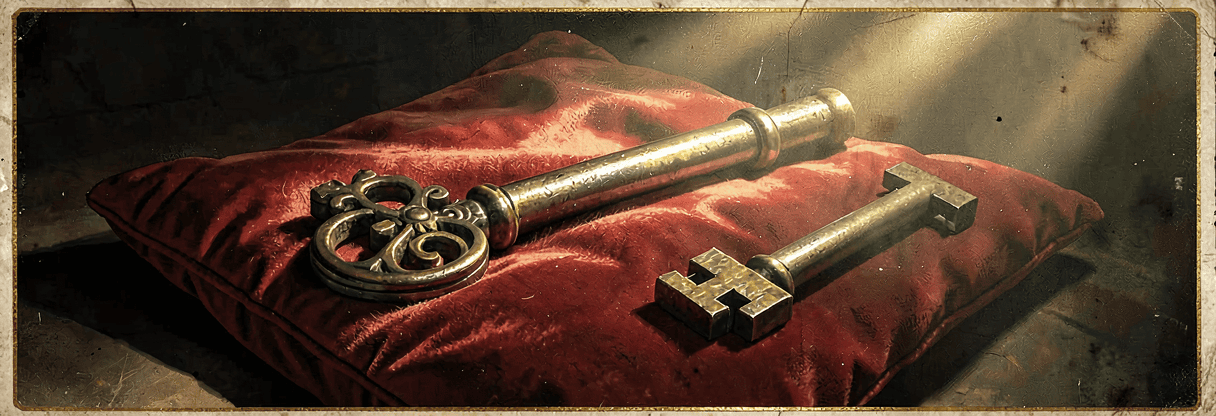
Across the Abrahamic traditions, the motif of keys consistently signifies the power to regulate access to a defined realm, yet the locus of this authority reveals profound theological distinctions. In the Hebrew Bible, Isaiah 22:22 depicts the transfer of the "key of the house of David" to Eliakim, symbolizing a dynastic shift in administrative stewardship within the earthly monarchy. This political metaphor finds a radical eschatological expansion in Christianity, where Matthew 16:19 records Jesus granting Peter the "keys of the kingdom of heaven," thereby delegating the authority to "bind and loose" regarding sin and salvation. Here, human agency participates in divine judgment, suggesting a participatory ecclesial structure where earthly decisions mirror heavenly realities. Conversely, Islamic theology rigorously counters any notion of delegated cosmic access. Surah 6:59 (Pickthall) asserts that "with Him are the keys of the Unseen," explicitly reserving knowledge of the hidden (al-ghayb) for God alone. While Judaism and Christianity utilize the key as a metonym for entrusted human responsibility over sacred boundaries, Islam employs the same imagery to underscore absolute divine exclusivity. The shared symbol thus illuminates a critical divergence: whether the sacred order permits mediated human authority or demands an unmediated, omniscient deity who alone controls the unseen. This tension defines the boundary between participatory stewardship and absolute sovereignty.
In the Isaiah narrative, the key is transferred from one steward to another, symbolizing the dynastic shift of political power within the Davidic monarchy rather than cosmic authority over the afterlife.
Christian texts expand the motif to include the power to 'bind and loose,' interpreting the keys as the authority to forgive sins and determine entry into the eschatological kingdom.
The Qur'anic text explicitly negates the delegation of the keys of the unseen to any being other than God, emphasizing divine exclusivity over hidden knowledge.
No one has written anything here yet. Some places to begin:
Sign in to join the discussion.