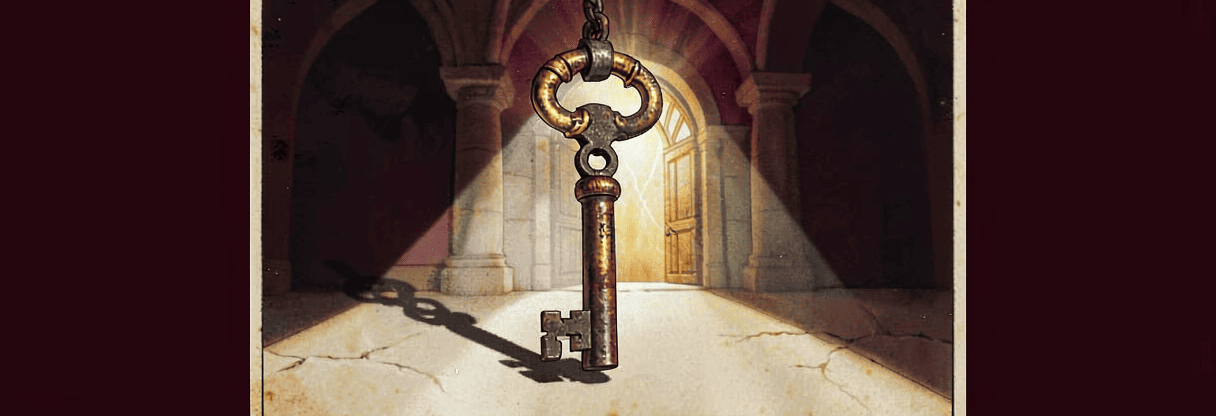
The Key
Authority to open and to shut — every tradition gives the key as the sign of stewardship, knowledge, and the gates of the kingdom.
"And I will give unto thee the keys of the kingdom of heaven: and whatsoever thou shalt bind on earth shall be bound in heaven..."
"Woe unto you, lawyers! for ye have taken away the key of knowledge..."
"I am he that liveth, and was dead; and, behold, I am alive for evermore... and have the keys of hell and of death."
"...These things saith he that is holy, he that is true, he that hath the key of David, he that openeth, and no man shutteth..."
See this theme as a comparative study.
- The Keys
The motif of keys functions as a metonym for divine authority to admit, exclude, or control access to sacred realms or hidden knowledge. While Judaism and Christianity depict keys as delegated authority given to human agents (the house of David or the apostle Peter) to bind and loose, Islam strictly reserves the keys of the unseen (al-ghayb) exclusively for God. This divergence highlights a theological tension between participatory ecclesial authority and absolute divine omniscience regarding the hidden.
- Keys, Binding, and Loosing
This parallel examines the delegated authority to define moral and legal boundaries within religious communities. While all three traditions posit a divine mandate for human agents to regulate conduct, the locus of this authority varies significantly. Christianity often locates this power in apostolic succession or ecclesial consensus, whereas Judaism centers it on the centralized High Court. Islam emphasizes the Prophetic role as the definitive legislator whose prohibitions are binding on the faithful.
Discussion
No one has written anything here yet. Some places to begin:
- Which verse landed hardest for you?
- What's a counter-text — a verse that complicates this theme?
- How does this theme show up in a tradition not represented here?
Sign in to join the discussion.