Judaism
Genesis
“And he dreamed, and behold a ladder set up on the earth, and the top of it reached to heaven: and behold the angels of God ascending and descending on it.”
This parallel examines the motif of a vertical axis connecting the terrestrial and celestial realms, manifesting as a physical ladder, a prophetic ascent, or a christological bridge. While Judaism and Christianity share the imagery of angels traversing this axis, Islam presents a singular, linear ascent of the prophet rather than a static structure for angelic traffic. Scholars debate whether the Islamic Mi'raj represents a re-interpretation of the Jacob narrative or a distinct eschatological event emphasizing the Prophet's unique proximity to the Divine.
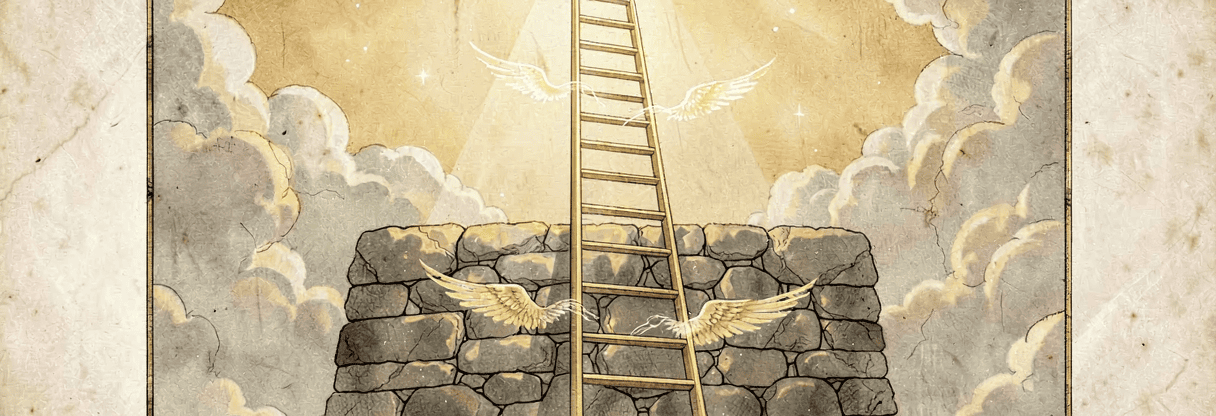
Across Abrahamic traditions, the vertical axis connecting earth and heaven serves as a critical locus for divine revelation. In Genesis 28:12, Jacob dreams of a ladder set upon the earth, where angels ascend and descend, marking Bethel as the gate of heaven. This static structure facilitates traffic between realms, emphasizing God's tangible presence at a specific location. Christianity reinterprets this imagery christologically. In John 1:51, Jesus declares, "Hereafter ye shall see heaven open, and the angels of God ascending and descending upon the Son of Man." Here, the structure becomes a person, transforming the ladder from a place into a living mediator. Islam offers a distinct divergence through the Mi'raj. Surah 17:1 describes the journey from the Sacred Mosque to the remote mosque, initiating a nocturnal ascent where the Prophet traverses the heavens personally. Unlike the stationary ladder of Genesis or the incarnate bridge of John, the Islamic narrative emphasizes the Prophet's unique proximity to the Divine at the Lote Tree of the Utmost Boundary. While all three traditions affirm a permeable boundary between human and divine, the mechanism of access varies significantly. Judaism locates sanctity in place, Christianity in person, and Islam in prophetic journey. These variations highlight differing theological emphases on mediation, revelation, and the nature of the sacred axis itself.
The ladder is a static structure set upon the earth, serving as a conduit for angels ascending and descending, establishing the site as the 'gate of heaven'.
The ladder is reinterpreted christologically, where the Son of Man replaces the structure itself, becoming the living bridge through which angels ascend and descend.
The motif shifts from a stationary ladder to a dynamic, nocturnal journey (Mi'raj) where the Prophet ascends through the heavens to the Lote Tree of the Utmost Boundary.
No one has written anything here yet. Some places to begin:
Sign in to join the discussion.