Christianity
Matthew
“Because strait is the gate, and narrow is the way, which leadeth unto life, and few there be that find it.”
Multiple traditions articulate a disciplined, exclusive path requiring moral rectitude and singular devotion, often contrasted with a broader, easier route of worldly complacency. While the imagery of a 'straight' or 'narrow' path is shared, the theological underpinnings diverge: Christianity frames it as a soteriological necessity for salvation, Islam as adherence to divine law and monotheistic orthodoxy, and Buddhism as a soteriological middle way avoiding extremes of asceticism and indulgence. Scholars note that while the metaphor implies a binary choice in Abrahamic faiths, the Buddhist 'Middle Way' functions as a methodological mean rather than a spatial constraint.
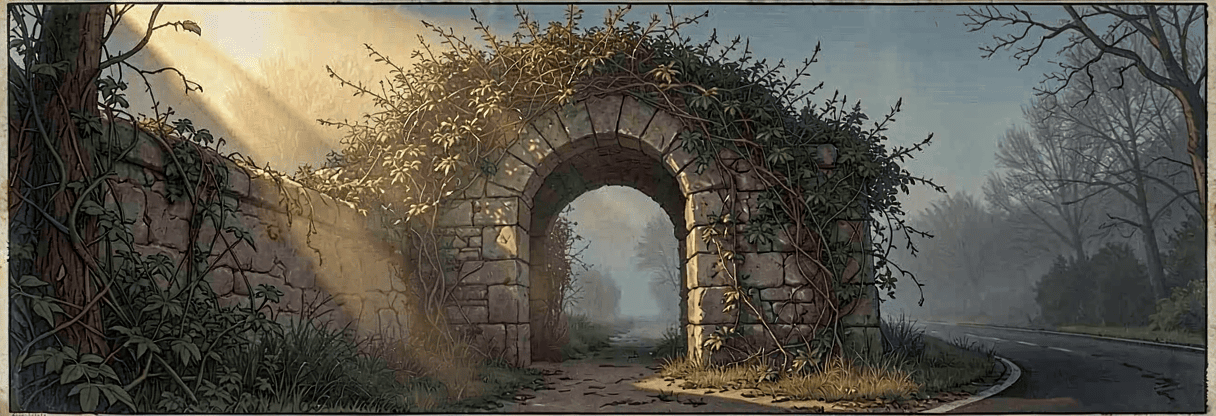
The metaphor of a singular, disciplined trajectory appears across Abrahamic traditions, yet its theological contours vary significantly. In Christianity, Matthew 7:14 presents the narrow way as an eschatological threshold: 'Because strait is the gate, and narrow is the way, which leadeth unto life, and few there be that find it.' Here, the path is defined by faith and repentance, framing salvation as a binary choice against the broad way of destruction. Islam similarly emphasizes exclusivity but grounds it in strict monotheistic submission. Surah 1:6 petitions, 'Guide us to the straight path,' while Surah 6:153 warns, 'follow not other paths, for they will separate you from His path.' For Islam, the Straight Path (al-sirat al-mustaqim) is the direct line of divine law, distinguishing believers from those who have erred. Judaism, however, offers a distinct nuance. Proverbs 4:18 describes the path of the just not as a narrow gate but as a 'shining light, that shineth more and more unto the perfect day.' This imagery suggests a progressive moral illumination within a covenantal community rather than a singular entry point. While all three traditions demand vigilance and moral rectitude, Christianity and Islam often emphasize the exclusivity of the route, whereas Judaism highlights a gradual ascent. Thus, the shared spatial metaphor serves divergent soteriological functions: a threshold of salvation, a line of submission, or a journey of increasing righteousness.
The narrow gate is presented as an eschatological threshold where few find it, emphasizing the exclusivity of salvation through Christ against the broad way of destruction. This reflects a binary soteriology where the path is defined by faith and repentance rather than mere ethical moderation.
The 'Straight Path' (al-sirat al-mustaqim) is defined by strict adherence to the covenant of monotheism and the law, distinguishing the believers from those who have incurred divine wrath or gone astray. It is less about a 'middle' between extremes and more about the direct, unswerving line of submission to God's will.
The 'path of the just' is depicted as a progressive illumination, growing brighter until the perfect day, emphasizing ethical conduct and Torah observance within a covenantal community. It focuses on the gradual moral ascent of the righteous rather than a singular, narrow entry point.
The practice of speech toward the divine — petition, adoration, silence.
The still small voice — every tradition keeps a chamber of quiet at the centre of speech. The God who speaks in whispers, the Tao that knows the world without going out.
The exodus from every Egypt — every tradition treats liberation as spiritual, not merely political.
The discipline that binds the neck — every tradition gives a yoke that is, paradoxically, the way of rest.
Distinct from the heart: the calculating, attending faculty — that which the Buddha treats as the master, and Paul as needing renewal.
The discipline of the tongue and the listening soul — every tradition treats silence as the venue of revelation and the seal of wisdom.
The way the soul must walk — every tradition figures the spiritual life as a road, and warns of every junction where the path divides.
No one has written anything here yet. Some places to begin:
Sign in to join the discussion.