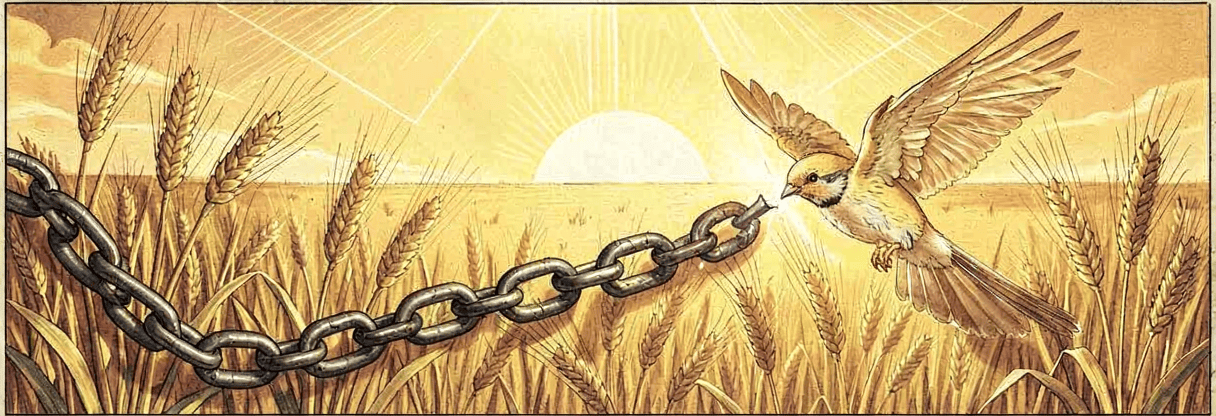
Freedom
The exodus from every Egypt — every tradition treats liberation as spiritual, not merely political.
"And Moses said unto the people, Remember this day, in which ye came out from Egypt, out of the house of bondage..."
"...he hath sent me to bind up the brokenhearted, to proclaim liberty to the captives..."
"And ye shall know the truth, and the truth shall make you free."
"Stand fast therefore in the liberty wherewith Christ hath made us free..."
"Without knowledge there is no meditation, without meditation there is no knowledge: he who has knowledge and meditation is near unto Nirvana."
"Let right deeds be thy motive, not the fruit which comes from them. And live in action!"
See this theme as a comparative study.
- Moses and the Exodus
A Hebrew infant is hidden, raised in Pharaoh's household, flees to the desert, encounters God at a burning bush, and returns to lead his people out of Egypt through parted waters. The foundational liberation narrative of Judaism; honoured in Christianity and Islam.
- The Narrow Way
Multiple traditions articulate a disciplined, exclusive path requiring moral rectitude and singular devotion, often contrasted with a broader, easier route of worldly complacency. While the imagery of a 'straight' or 'narrow' path is shared, the theological underpinnings diverge: Christianity frames it as a soteriological necessity for salvation, Islam as adherence to divine law and monotheistic orthodoxy, and Buddhism as a soteriological middle way avoiding extremes of asceticism and indulgence. Scholars note that while the metaphor implies a binary choice in Abrahamic faiths, the Buddhist 'Middle Way' functions as a methodological mean rather than a spatial constraint.
- The Prodigal's Return
This parallel examines the motif of the estranged soul returning to divine favor across Abrahamic and Buddhist traditions. While Christianity and Islam emphasize a personal God who actively awaits and forgives the repentant sinner, the Buddhist account in the Dhammapada frames the 'return' as an internal realization of the Dhamma rather than a relational reconciliation with a deity. Scholars note that the Abrahamic narratives often involve a narrative of restoration to community status, whereas the Buddhist verse focuses on the cessation of suffering through self-discipline. The shared core remains the transition from a state of error or loss to one of spiritual restoration.
- Leaving All Behind
Multiple traditions articulate the necessity of relinquishing material attachments to attain spiritual liberation or divine favor. While Christianity and Islam emphasize the ethical redistribution of wealth and the prioritization of the afterlife, Buddhism frames renunciation as a psychological detachment from the cycle of desire. Scholars note that in the Abrahamic traditions, the act is often a specific test of obedience or a communal obligation, whereas in Buddhism, it constitutes the fundamental definition of the monastic path.
- The Promised Land
The concept of a divinely pledged inheritance unites these traditions, though the locus of fulfillment shifts from a specific geopolitical territory in Judaism to a universalized, often eschatological realm in Christianity and Islam. In Judaism, the promise is concretely tied to the land of Canaan as an eternal possession for the descendants of Abraham. Christianity reinterprets this inheritance as a heavenly country and an eternal Sabbath rest, transcending physical borders. Islam similarly universalizes the promise, identifying the righteous inheritors of the earth as those who submit to God, often pointing toward a paradisiacal existence or a purified world order.
Discussion
No one has written anything here yet. Some places to begin:
- Which verse landed hardest for you?
- What's a counter-text — a verse that complicates this theme?
- How does this theme show up in a tradition not represented here?
Sign in to join the discussion.