Christianity
Mark
“And he taught, saying unto them, Is it not written, My house shall be called of all nations the house of prayer? but ye have made it a den of thieves.”
This parallel examines the motif of religious leaders purifying a sacred sanctuary from commercial or idolatrous corruption. While the Christian Gospels and Hebrew Prophets frame the Temple in Jerusalem as a 'house of prayer' defiled by commerce, Islamic tradition narrates the purification of the Ka'ba from idolatry through the agency of Abraham. Scholars note that the Christian narrative is eschatological and messianic, whereas the Islamic account is hagiographical and foundational to the sanctity of the site, with the Hebrew texts serving as the prophetic warrant for the former.
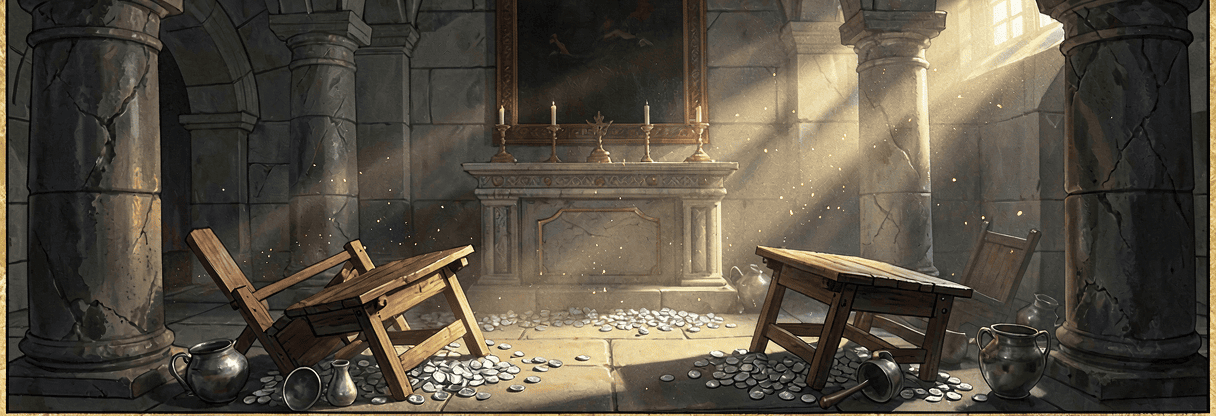
Across the Abrahamic traditions, the motif of purifying a sacred sanctuary serves as a critical theological pivot, revealing shared anxieties about the integrity of divine worship. In each narrative, a central figure confronts the corruption of a dwelling place designated for the Divine, whether through idolatry or exploitative commerce. The Hebrew prophets, particularly in Jeremiah 7:11, issue a scathing indictment: "Is this house, which is called by my name, become a den of robbers in your eyes?" Here, the focus is not a singular historical event but a prophetic warrant against the belief that ritual safety exists without ethical conduct. Similarly, the Gospel of Mark records Jesus invoking this same prophecy, declaring, "My house shall be called of all nations the house of prayer," yet framing the act as an eschatological sign within Passion Week rather than a cultic reform. In contrast, Islamic tradition, as reflected in Surah 21:58, narrates the primordial purification of the Ka'ba by Abraham and Ishmael, who destroy idols to restore monotheistic purity. While the Jewish and Christian accounts critique the socio-economic and ritualistic abuses of the Second Temple period, the Islamic account establishes the foundational sanctity of the site by rejecting shirk. Thus, while all three traditions affirm the sanctuary as a space for exclusive devotion, they diverge significantly: the Hebrew texts offer moral critique, the Christian narrative signals a new covenantal reality, and the Islamic account secures the site's eternal, pre-Abrahamic purity.
The narrative is situated within the Passion Week, presenting Jesus' action as a messianic sign fulfilling prophecy rather than a historical reform of the cult. The focus is on the displacement of the Temple's sacrificial system by a new mode of worship.
The texts function as prophetic indictments against the socio-economic exploitation of the poor rather than a narrative of a single cleansing event. The 'den of robbers' metaphor critiques the belief that ritual sacrifice guarantees safety while ethical conduct is neglected.
The account is set in deep antiquity with Abraham and Ishmael, establishing the primordial purity of the Ka'ba before the advent of Islam. The narrative emphasizes the rejection of polytheism (shirk) rather than the regulation of commercial trade within the sanctuary.
No one has written anything here yet. Some places to begin:
Sign in to join the discussion.