Christianity
Mark
“And he arose, and rebuked the wind, and said unto the sea, Peace, be still. And the wind ceased, and there was a great calm.”
These narratives across Abrahamic traditions depict the divine command as the ultimate authority over natural chaos. While the Christian account emphasizes Christ's inherent authority, the Jewish psalm highlights Yahweh's covenantal protection, and the Islamic narrative underscores prophetic reliance on divine decree. Scholars note that these variations reflect distinct theological emphases on the nature of divine power and human salvation.
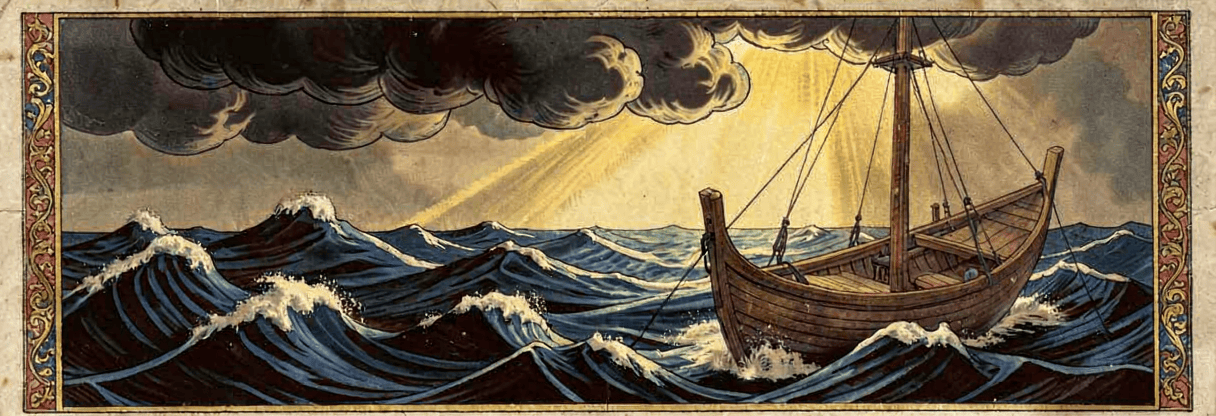
Across Abrahamic traditions, the motif of the storm stilled serves as a profound theological locus where divine sovereignty confronts existential chaos. In Mark 4:39, the narrative depicts Jesus rising to rebuke the wind, commanding, "Peace, be still." This act asserts an inherent authority over nature, distinguishing the figure from a mere intercessor and grounding early Christological claims in direct divine power. Conversely, the Hebrew Psalms frame similar deliverance within a covenantal relationship. Psalm 107:29 states, "He maketh the storm a calm, so that the waves thereof are still," emphasizing Yahweh's protective fidelity to the faithful rather than a messianic intervention. Here, the stilling of waters confirms God's enduring promise to preserve His people amidst peril. Islamic tradition, particularly in the narrative of Noah within Surah Hud, presents the cessation of the flood as a fulfillment of divine decree. The command, "O earth, swallow thy water, and O sky, withhold (thy rain)," underscores the Prophet's role as a witness to God's will rather than an agent of independent power. While all three traditions affirm that natural chaos yields to a singular divine command, the theological center of gravity shifts: Christianity locates authority in the person of the commander, Judaism in the covenantal protector, and Islam in the absolute decree of the Sovereign. These variations illuminate distinct understandings of how salvation is mediated through the ordering of creation.
In Mark, Jesus exercises inherent divine authority to command the elements, reflecting early Christological claims. This distinguishes the figure from a mere prophet acting through intercession.
The Psalmist attributes the calming of the storm directly to Yahweh's sovereign power within a covenantal framework. This reflects a focus on God's protection of the faithful rather than a specific messianic intervention.
The Quranic narrative of Noah emphasizes the divine command as a decree that reverses the floodwaters. It underscores the Prophet's role in witnessing the fulfillment of God's will rather than exercising independent power.
Water represents cleansing, life, and the Holy Spirit's refreshing work. It is used in baptism to signify death to sin and new life.
The fire that purifies and the fire that consumes — every tradition warns the wrath of God against the wrath of man, and every tradition makes the slow heart its student.
The mind that hesitates between two opinions — every tradition treats it not as enemy of faith but as its proving ground.
The waters under the firmament — every tradition makes the sea the figure of the chaos that the Lord rebukes and the depth that the soul must cross.
The whirlwind that the LORD answers from, the tempest that the disciples cry through — every tradition makes the storm the venue of address and of mastery.
No one has written anything here yet. Some places to begin:
Sign in to join the discussion.