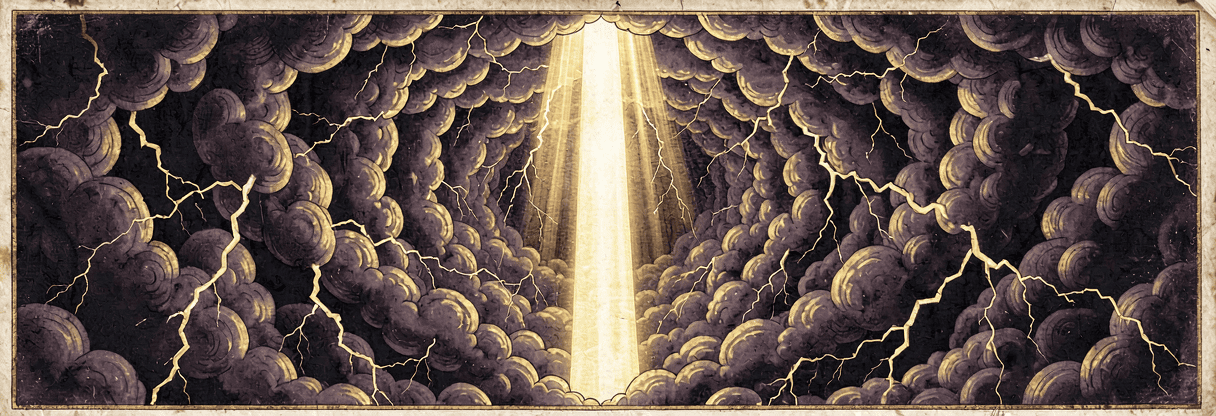
The Storm
The whirlwind that the LORD answers from, the tempest that the disciples cry through — every tradition makes the storm the venue of address and of mastery.
"Then the LORD answered Job out of the whirlwind, and said,"
"...and a great and strong wind rent the mountains, and brake in pieces the rocks before the LORD; but the LORD was not in the wind:"
"He maketh the storm a calm, so that the waves thereof are still."
"But the LORD sent out a great wind into the sea, and there was a mighty tempest in the sea, so that the ship was like to be broken."
See this theme as a comparative study.
- The Storm Stilled
These narratives across Abrahamic traditions depict the divine command as the ultimate authority over natural chaos. While the Christian account emphasizes Christ's inherent authority, the Jewish psalm highlights Yahweh's covenantal protection, and the Islamic narrative underscores prophetic reliance on divine decree. Scholars note that these variations reflect distinct theological emphases on the nature of divine power and human salvation.
- When the Place is Shaken
Across these traditions, seismic disturbances serve as tangible markers of divine intervention within the material realm. While the Hebrew Bible and Acts associate shaking with covenantal revelation or the Spirit's empowerment, the Qur'an predominantly frames it as an eschatological dissolution of the cosmos. Scholars debate whether these accounts reflect literal geological events or metaphorical descriptions of awe-inspiring theophany. Nevertheless, all three converge on the motif that the sacred order disrupts the natural order to establish authority.
Discussion
No one has written anything here yet. Some places to begin:
- Which verse landed hardest for you?
- What's a counter-text — a verse that complicates this theme?
- How does this theme show up in a tradition not represented here?
Sign in to join the discussion.