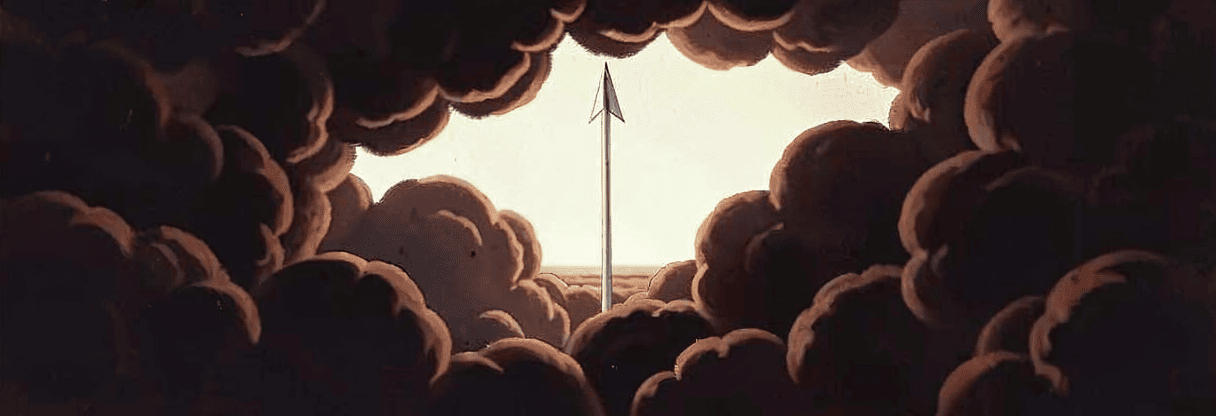
Hope
The forward-looking sister of faith — every tradition turns the eye to a future the soul cannot yet see.
"Why art thou cast down, O my soul? and why art thou disquieted in me? hope thou in God..."
"This I recall to my mind, therefore have I hope."
"And hope maketh not ashamed; because the love of God is shed abroad in our hearts by the Holy Ghost..."
"Now faith is the substance of things hoped for, the evidence of things not seen."
"...O My servants who have transgressed against themselves [by sinning], do not despair of the mercy of Allah..."
See this theme as a comparative study.
- The Promised Land
The concept of a divinely pledged inheritance unites these traditions, though the locus of fulfillment shifts from a specific geopolitical territory in Judaism to a universalized, often eschatological realm in Christianity and Islam. In Judaism, the promise is concretely tied to the land of Canaan as an eternal possession for the descendants of Abraham. Christianity reinterprets this inheritance as a heavenly country and an eternal Sabbath rest, transcending physical borders. Islam similarly universalizes the promise, identifying the righteous inheritors of the earth as those who submit to God, often pointing toward a paradisiacal existence or a purified world order.
- Death Before Life
The motif of death preceding fruitfulness appears in Christian soteriology, Jewish agricultural wisdom, and Hindu metaphysics of the soul. While Christianity and Hinduism explicitly link the 'death' of the agent to a subsequent state of being (resurrection or rebirth), Jewish texts often frame the 'sowing' as an act of faith where the outcome is divinely guaranteed rather than ontologically necessary. Scholars note that the Christian and Hindu parallels rely on a transformation of identity, whereas the Jewish parallel emphasizes the temporal delay between sacrifice and reward.
- The Tomb They Found Empty
This parallel examines the motif of divine deliverance from death across three Abrahamic traditions. While all affirm God's power to reverse separation from the divine, the mechanisms differ significantly. Christianity asserts a bodily resurrection following confirmed death, whereas Islam maintains the figure was never killed but raised directly. Jewish texts often employ this language typologically for national redemption rather than individual resurrection.
Discussion
No one has written anything here yet. Some places to begin:
- Which verse landed hardest for you?
- What's a counter-text — a verse that complicates this theme?
- How does this theme show up in a tradition not represented here?
Sign in to join the discussion.